
400 Years of United States Content
Afterword
When I first came to the United States, I knew very little about the country. My education in mainland China had instilled the idea that “American imperialism is aggressive.” After arriving in the U.S., I was busy making a living, and only after retiring did I have the time to explore the origins and development of America, asking myself: Why is America so strong?
Starting from Columbus’s discovery of the New World, I traced the clues and realized that for the first 100 years, the Americas were largely dominated by Spain. Spain conquered an indigenous nation in Mexico and later destroyed the Inca Empire in South America, seizing immense amounts of gold and silver. Yet Spain failed to become the enduring “king of the Americas.”
In North America at that time, vast wilderness stretched as far as the eye could see. Indigenous people had few permanent settlements, and Spanish control was mostly nominal. It took over a century for the British to establish colonies and cultivate the land, eventually forming the thirteen colonies that became the United States. Over two to three centuries of expansion and development, the U.S. rose to become the world’s leading power. How did a nation starting from essentially nothing surpass Spain? Some attribute it to education, others to science or favorable geography. Tracing the root causes, however, it seems cultural and religious foundations were decisive. Americans, shaped by the Protestant Reformation and New England Puritan values, practiced a faith-driven ethic that greatly contributed to their achievements, whereas the Spaniards adhered to conservative Catholicism.
Studying American history, I am still saddened by the Civil War. I cannot fully understand why a nation with over 80 years of democratic tradition resorted to guns instead of parliamentary debate, leading to hundreds of thousands of deaths, scorched lands, and even presidential assassinations. I am perplexed by the long-standing poverty in Harlem, Chicago’s Black neighborhoods, and recurring issues of public safety and racial tension. Are these lingering effects of the Civil War?
Learning American history also taught me about Liberia. Before the Civil War, some well-intentioned Americans relocated freed slaves to Africa, teaching them survival skills. Wasn’t that a better approach than chaotic violent emancipation, which left so many unresolved issues? I once speculated that if a British monarch had still governed, perhaps the horrific Civil War could have been avoided.
Regarding Franklin Roosevelt, I learned that President Hoover had already warned that an alliance with Stalin would be disastrous. Why, then, did Roosevelt feel compelled to cooperate with the communist dictator, effectively enabling the rapid expansion of a “socialist camp” that assisted Mao Zedong in taking over China, causing tens of millions of deaths? Even today, I remain unsure how to assess the actions of Stalin and Truman in these contexts.
In recent years, I have also questioned American democracy. How could a television entertainer and real-estate magnate, essentially a “magician” in media and business, rise to the presidency, evade impeachment, and even maintain a strong re-election momentum? Yet I believe in the thousands of legal scholars, historians, and journalists whose voices represent conscience and reason. I trust that even the deceived public will eventually awaken. The foundation of freedom of speech in the U.S. is strong, and I remain confident in American democracy.
Looking back at the past century of American and world history, I am deeply aware of the profound influence the United States exerts globally—truly, “America decides the world.” When America acts rightly, the world prospers; when America errs, the world suffers. I hope that more presidents like Woodrow Wilson will emerge, guiding America along the path set by the Puritans 400 years ago. May God bless America!
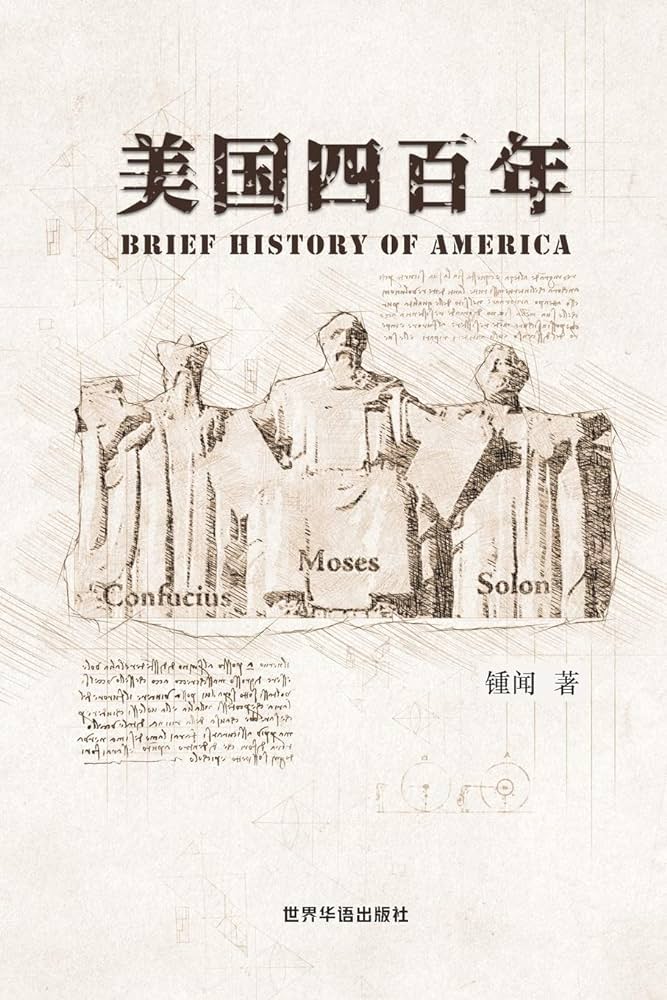
Four Hundred Years of America is my personal study and reflection written in retirement. I am fully aware that it contains my own biases and errors. Fortunately, freedom of speech in the U.S. allows one to critique any president without fear; mistakes are addressed openly.
I wish to express special gratitude to contemporary thinker Wang Kang, who wrote over 20,000 words of preface for this book while seriously ill, sharing his reflections on the U.S., China, and the modern world. Unfortunately, the original file was lost but will be included in future editions.
After emigrating to the U.S., Wang Kang, like his admired Soviet writer Aleksandr Solzhenitsyn, lived quietly near Washington, D.C. While bedridden in May of this year, he was baptized as a Christian and applied for U.S. citizenship. Although the pandemic delayed formal processing, Congress granted him a flag flown over the Capitol as recognition of his status as a spiritual American citizen. Wang Kang is the only Chinese writer and thinker to receive this honor, and his preface greatly enriches this book.
I am also grateful for the prefaces written by Yu Jinshan, chairman of the Chinese Consolidated Benevolent Association in New York; Xu Wenli, a renowned Chinese democracy activist in exile; my friend and writer Cai Kefeng; and veteran journalist Ye Yongkang.
—Zhong Wen
May 21, 2020
THE END
 正义钟声 Voice of Justice