
400 Years of United States Content
Preface IV: A Fine Guide to American History
Cai Kefeng
Forty-four years ago, when I first arrived in Hong Kong, I was eager to learn the truth about current affairs and history—especially modern Chinese history and the historical realities of other capitalist countries. On the Chinese mainland, I had encountered history textbooks from elementary school through middle and high school, but they were so brief as to be crude. With even a little careful reading and inquiry, one could sense how many blanks there were, how many contradictions appeared in the historical narrative, leaving the reader full of doubts.
Later, I was admitted to an engineering university, where no courses in literature, history, philosophy, or the humanities were offered at all. Out of personal interest, I often searched the university library for fragments and unofficial histories. I also shared some of my views with friends at Sun Yat-sen University who taught or studied the humanities. Unexpectedly, one of my closest friends warned me: if you were a student here and raised such doubts, it would be very dangerous. During the Anti-Rightist Campaign, many teachers and students were persecuted because their everyday remarks were actively collected by class or departmental cadres and reported upward, entered into personal files, and then used to label them as reactionary rightists, who were subsequently purged…
From that point on, I no longer dared let others know of my interest in the humanities, let alone voice doubts. Soon afterward, the Cultural Revolution arrived. I saw clearly that people whose questions were far milder than mine—“no matter how high their position or how senior their status”—could not escape disaster. Once their words were “infinitely escalated,” they became crimes against the Party and against socialism; their political lives were stripped away, they were reduced to pariahs, and some even lost their lives.
After risking my life to escape illegally and reaching British-ruled Hong Kong, I personally experienced the exhilaration that comes with an environment of freedom of thought and expression. Once basic needs like simple food and drink were met, the need for spiritual nourishment naturally followed. I became a regular at libraries in Central, Hong Kong. In less than half a year, together with friends, I helped found Beidou Monthly. The common trait among the magazine’s contributors was this: each made public his own understanding, combined with personal experience, to supplement and become part of China’s recent history.
To completely destroy a country or a nation, mass killing is not the only method; more importantly, one must destroy its culture. Judging from the dozens of so-called “milestones” proclaimed by the Chinese Communist Party’s own party history, each is worse than the last. Moreover, every group that won internal Party struggles and ascended to a quasi-sacred status proceeded to recompile and heavily distort Party history. For anyone who collects modern history, leafing through nearly a century of CCP party history leaves one feeling that it is “a page full of absurdities” and a source of the Chinese people’s “bitter tears.” Such distortion is undoubtedly a process by which Chinese culture—and even individual moral character—is destroyed from within, without the need for any external enemy. A party, a state, and a nation that lack even a detailed modern history—do they still have any value or standing in the community of humankind?
They have also gone to great lengths to distort American history. In recent years, some mainland netizens have even cursed President Washington, claiming that the leather boots he wore were made from the skins of Native Americans. Such information has circulated widely on the Chinese mainland. Even though Fang Zhouzi angrily attempted to debunk it, he could not suppress it. This shows that many Chinese people are not only blind to their own history, but also slander or remain confused about American history and current affairs—degenerating even into shamelessness.
If we talk with Chinese Americans living in New York—even those who immigrated recently from the mainland—we find that most are extremely impoverished in their knowledge of Chinese current affairs and history. They often excuse themselves by saying they dislike talking about politics; as for American history, that is even more neglected. Tragically, the less people understand, the more easily they become “little pinks,” their minds filled with ideological paste, parroting CCP propaganda and taking pride in being subjects of a “rising great power.” When I criticize them for neglecting the democracy, freedom, and human rights they ought to enjoy, they seem even more at a loss.
In fact, in the United States it is not difficult at all to consult detailed histories covering nearly four hundred years of American development. Take New York as an example: libraries are so densely distributed that within a half-hour walk one can reach a branch. The collections of different libraries complement one another; librarians are ready to answer questions and provide enthusiastic service. One can only hope that after coming to America, such people will gradually compare experiences firsthand, read more beneficial books and periodicals, and change. Otherwise, they and their next generation will become completely opposing groups.
It is also worth mentioning that some historians, noting that Native Americans share certain similarities in skin tone and facial features with East Asians, have speculated whether they might be descendants of people from the Shang and Zhou periods who fled Asia across the sea four thousand years ago. Others wonder whether some ships from Zheng He’s voyages six hundred years ago might have been lost and reached the Americas—earlier than Columbus. And so on. Chinese people always like to claim a bit of credit for themselves. These ideas are entirely unfounded, but they can at least raise a smile.
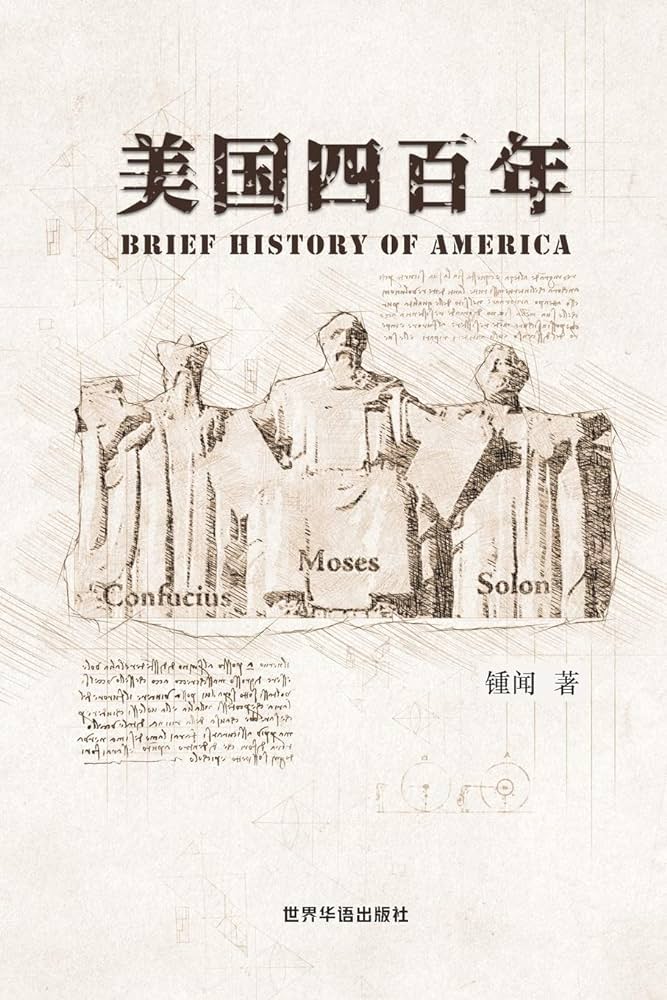
Mr. Zhong Wen’s Four Hundred Years of America restores historical clarity. For overseas Chinese who wish to understand American history, this is a very good thing. The book cannot be called a monumental work; rather, it should be regarded as a concise Chinese-language introductory reader, very helpful for those whose English still needs improvement and who are humble and eager to learn about American history. The book’s basic content and structure are clear and engaging, making it suitable as an introductory guide. If it thereby inspires readers to pursue deeper study of American history, so much the better—for the author and for the readers alike.
 正义钟声 Voice of Justice