
Roosevelt: The Mastermind Behind Eight Decades of Communist Disaster
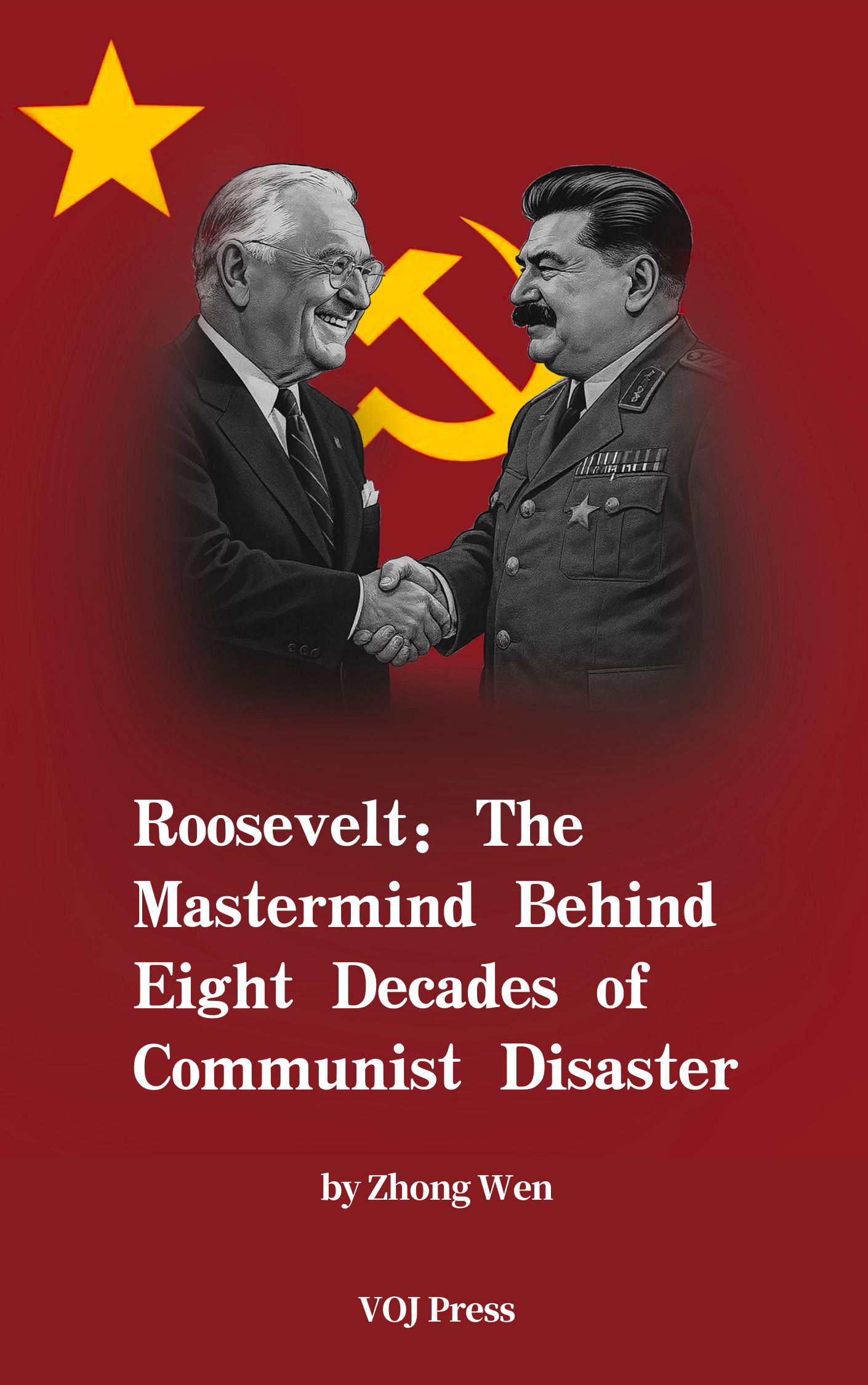
Chapter 19
The Hundred-Year Marathon Just Awakens from a Dream
III. The Hundred-Year Marathon Cannot Stop Appeasement
Although The Hundred-Year Marathon was published nearly a decade ago, appeasement has not stopped — in fact, it continues. A 2019 April 19 article on BBC Chinese titled “Lessons from the Cold War: Churchill’s “Percentages” and Russia’s Fear is a prime example of this. The article serves as a spokesperson for the sordid deal between Stalin and Churchill.
Churchill told an American journalist, “stalin never broke his word with me. We reached an agreement over the Balkans. I said he could have Romania and Bulgaria, and he said we could have Greece…… When we entered (Greece) in 1944, Stalin did not intervene.”
The UK National Archives launched a Cold War history exhibition commemorating the 70th anniversary of NATO’s founding and the 30th anniversary of the fall of the Berlin Wall. Archivists said they hoped these Cold War documents would help people understand the secrets, suspicions, fears, political tensions, and ideological conflicts of East and West during that era.
The exhibition displayed the original “Percentages Agreement” documents — dubbed “naughty papers” by Churchill — which divided Eastern Europe into spheres of influence near the end of World War II. Churchill and Stalin made this deal.
More than a year later, Churchill gave his famous “Iron Curtain” speech in the US, describing the Soviet Union and Eastern European socialist countries as “shrouded by an iron curtain.” The “Iron Curtain” speech became one of the key markers of the Cold War’s start.
The pragmatic attitude Churchill showed during the “Percentages Agreement” in late WWII, when the Soviet Red Army was still advancing, contrasts with his firm anti-communist stance in the 1946 “Iron Curtain” speech. By 1947, the US and Soviet camps had formed and the Cold War began.
In October 1944, Churchill and Stalin met at the fourth Moscow Conference to discuss postwar spheres of influence in Eastern Europe. The US ambassador to the USSR, Harriman, representing President Roosevelt, was excluded from their private talks.
In this “Percentages Agreement”, Churchill wrote percentages on a piece of paper dividing influence over different European countries, and Stalin marked it with a big blue check.
Churchill wrote in his memoirs that he handed Stalin a sheet with the percentages marked for British and Soviet influence in various European countries. According to Carlton’s Churchill and the Soviet Union, Churchill later said, “stalin took the blue pencil and marked a big tick on it, then handed the paper back to us.”
The UK demanded 90% control over Greece, and the Soviets were allowed 90% in Romania. Both sides controlled 50% in Yugoslavia and Hungary. The Soviet influence was 75% in Bulgaria, with Britain 25%.
American historian Henry Butterfield Ryan, in Anglo-American Relations: The Emergence of the Cold War 1943–1946, says that in subsequent discussions, British Foreign Secretary Eden and Soviet Foreign Minister Molotov haggled over the percentages like bargaining in a market, with Molotov successfully trimming Churchill’s percentages.
The final numbers showed the Soviets with an 80% advantage in Bulgaria and Hungary, and only 20% for Britain. Soviet control in Romania increased to 100%.
Ryan states that Churchill was anxious that the US had not yet reached an agreement with the Soviets on Europe’s spheres of influence, believing the Soviet Red Army would not stop advancing in Europe without a formal agreement with Moscow.
Many historians regard the “Percentages Agreement” as profoundly significant, some comparing it with the Yalta and Potsdam agreements. They argue these agreements placed Eastern Europe under Soviet influence.
Under Putin, Russia has increasingly been viewed by the West as a threat, with many fearing a renewed military and ideological confrontation reminiscent of the Soviet era.
After WWII, with Britain’s full control over Greece, Churchill tried to renege on the “Percentages Agreement.” Historian Melvyn Leffler believes Churchill and Roosevelt kept the agreement secret from their successors, reflecting their attitudes toward it.
At the 1945 Yalta Conference, Roosevelt proposed that the “Percentages Agreement” be decided by the newly formed United Nations. The US proposal angered Stalin, who wanted to place Eastern Europe under Soviet control.
Stalin sought to establish a strategic buffer zone in Eastern Europe beyond the Soviet border after defeating Nazi Germany to prevent another Napoleon or Hitler from arising in Europe.
Initially, Stalin was confident in this secret agreement, even believing its importance exceeded that of the public Yalta agreements. Later, Stalin felt betrayed by Britain and the US.
In 1956, Churchill told American journalist C. L. Sulzberger, “stalin never broke his word with me. We agreed on the Balkans. I said he could have Romania and Bulgaria, he said we could have Greece…… When we entered Greece in 1944, Stalin did not interfere.”
George Kennan, the founder of the US policy of containment of the USSR, said in his 1946 long telegram that the Kremlin’s neurotic view of world affairs was rooted in deep insecurity. Persistent fear and concern over invasion have been consistent in Soviet and Russian foreign policy.
After the Berlin Wall fell and Germany unified, Soviet leader Gorbachev insisted a unified Germany should not join NATO. He told US Secretary of State Baker, “NATO was an organization hostile to the Soviet Union from the start,” and the Soviets could not accept NATO’s expansion.
After the Soviet collapse, Yeltsin pressured the US over NATO’s eastward expansion. He told President Clinton that NATO admitting former Warsaw Pact countries “sowed seeds of distrust.” In 1995, Yeltsin warned Clinton that allowing NATO’s borders to expand to Russia would be “a betrayal of the Russian people.”
During Putin’s tenure, much effort has been devoted to restoring the Soviet-era economic space and security boundaries to counter NATO and EU expansion. In 2005, Putin called the Soviet collapse the “greatest geopolitical disaster” of the 20th century.
Former Israeli leader Peres said Putin is not the enemy of the US and Europe. In a private 2016 conversation, Putin said, “What do they (Americans) need NATO for? Who do they want to fight? Don’t they think I know Crimea is Russian, given Khrushchev gave it as a gift to Ukraine? Before you try to bring Ukraine into NATO, I don’t care. What for? I haven’t touched them.”
After Russia annexed Crimea in 2014, the West increasingly viewed Putin’s Russia as a new threat. Last year, a former Russian spy was targeted in the UK with poisoning, leading to mutual accusations and diplomatic expulsions, plunging UK-Russia relations to their lowest point since the Cold War ended.
Many commentators believe the world has entered a new “Cold War,” resembling the ideological and military confrontation between the Soviet Union and the West from the early 1950s to the late 1980s. The “Percentages Agreement” was an acknowledgment by great powers of the balance of power reality, and when realpolitik gave way to ideology, the “Cold War” began.
The UK National Archives exhibition ends by asking the public: Do you think the world is safer now? Most answered no. Many said we have learned nothing from history. Some commented, “the world might be a little safer now, but balance must be maintained so that Russia and China do not feel threatened.”
— Oh my, even the BBC says “don’t let Russia and China feel threatened!” Do they really not know who threatens whom?
Zhong Wen remarked: The Hundred-Year Marathon was published in 2015, yet few decision-makers have recognized it, and no countermeasures have been implemented. This is because Roosevelt’s pernicious paradigm caused presidents to fail to realize the truth generation after generation — 80 years of shared disaster beginning with Roosevelt, passed down without awakening. In 2021, President Biden again refused to hold Xi Jinping accountable for manufacturing and spreading the pandemic and made peace with him. In 2022, Biden tacitly accepted Xi’s illegal third term after 10 years of dictatorship. In 2023, Xi caused another incident to eliminate Li Keqiang to prevent future troubles.
The CCP’s Hundred-Year Marathon has succeeded obviously due to strong international assistance. To say it nicely, Western politicians were deceived; to say it harshly, the fifth column of “pro-CCP” agents runs rampant! The Hundred-Year Marathon obviously cannot stop the spread of appeasement everywhere.
 正义钟声 Voice of Justice