
Roosevelt: The Mastermind Behind Eight Decades of Communist Disaster
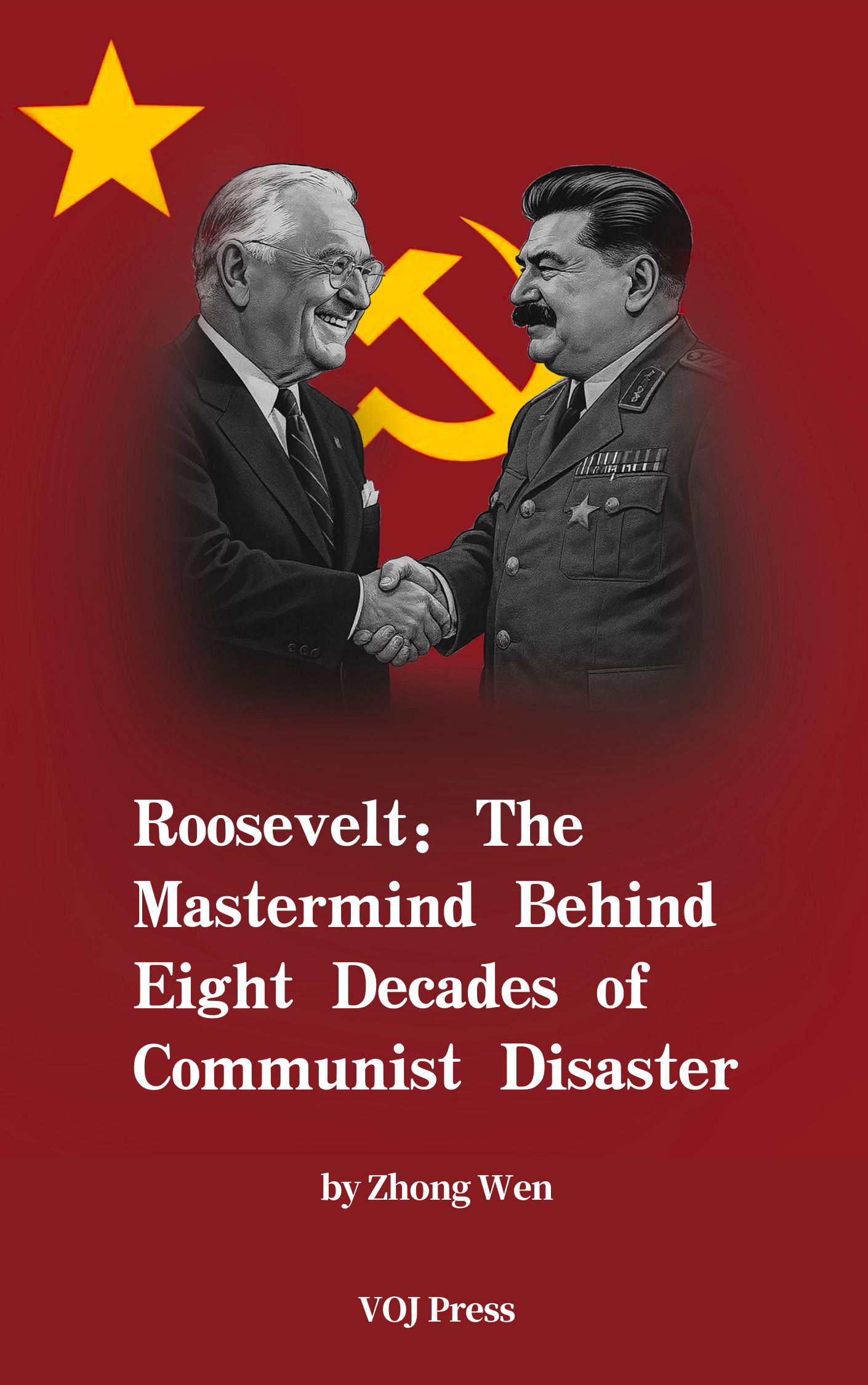
Chapter 14
Eisenhower’s Strategic Misstep on the Global Stage
One of Roosevelt’s gravest policy blunders was his failure to recognize the dangers of communism and his naive belief that the devilish Stalin was a “good man”. Especially regarding the situation in Northeast China, Roosevelt sacrificed essential principles under the pretext of military necessity. In truth, Japan’s surrender had nothing to do with the Soviet Union’s entry into Manchuria. Tragically, Eisenhower — faithfully carrying out Roosevelt’s misguided intentions — ended up handing over Eastern Europe to the devil Stalin, yet still managed to get elected president of the United States. This kind of absurd and catastrophic behavior would prove to be a deep-rooted threat, accelerating America’s decline from its peak.
I. Eisenhower’s Cowardly “Peaceful Evolution” Doctrine
As Truman’s successor, Eisenhower was just another coward. He clung to the idea of “peaceful evolution” as a form of self-comfort, while shifting the blame for his war-averse policies onto others.
Some claim that Secretary of State John Foster Dulles — not Eisenhower — was the main architect of U.S. foreign policy, arguing: “It was Dulles who proposed the policies, persuaded the president, and executed the strategies …… In effect, he became the true wielder of power in the United States.”
This assertion, however, is inaccurate. In reality, Dulles’s authority stemmed directly from Eisenhower.
The myth of Eisenhower didn’t begin to rise until the 1970s, when a traumatized and disillusioned American public — scarred by the Vietnam War and economic crisis — began to nostalgically recall the relative peace and prosperity of the 1950s, and America’s “leadership status” during that time.
Since 1975, the gradual declassification of official and private documents at the Eisenhower Presidential Library has helped fill in some of the gaps about his administration.
In his book Eisenhower and the Cold War, historian Robert Divine argues that Eisenhower’s influence was seriously underestimated. According to Divine, Eisenhower merely used Dulles’s diplomatic expertise as a tool. Divine believed that Eisenhower’s main accomplishment was avoiding foreign military interventions — an achievement largely negative in nature, but which helped keep the Cold War under control and averted nuclear war. His restraint, prudence, and caution were qualities rarely matched by his successors.
Anna Nelson’s research on Eisenhower’s relationship with the National Security Council led to similar conclusions. Fred Greenstein emphasized Eisenhower’s hidden leadership style, suggesting he quietly controlled the policymaking process behind the scenes and made key decisions — while allowing Dulles to act as a lightning rod for criticism and controversy over Cold War policy.
Clearly, Eisenhower’s appeasement and retreatist tendencies were cut from the same cloth as Roosevelt’s submissiveness toward the Soviet Union. The former Allied Supreme Commander inherited Roosevelt’s legacy of pandering to Moscow — and still got elected president, just like his predecessor.
British historian Paul Johnson’s Modern Times: The World from the Twenties to the Nineties traces the turbulent narrative of the 20th century: two world wars, a global depression, the rise and fall of communism, the collapse of empires. Historical interpretation deeply shapes our vision for the future.
One recurring theme in Johnson’s work is this: “Roosevelt’s blunders cost the world 44 wasted years.” In other words, if not for Roosevelt’s late-stage syphilitic delusions and deranged decisions, the evil empire of the Soviet Union would have been crushed by Nazi Germany in their internal bloodbath—long before it had the chance to survive into 1991 and poison half the world with communism.
The Yalta Conference, dominated by Roosevelt, turned China into one of its greatest victims. Ultimately, it led to regime collapse and Soviet control. China wasn’t even allowed to participate in the Yalta Conference — even though it was a major Allied power and the discussions directly impacted the future of East Asia. The full terms of the agreement weren’t even shared with the Chinese until August 14 — after the Soviets had already declared war and the pact was irreversible.
Stalin got everything he wanted without giving up a thing. The U.S. and Britain could never justify such a betrayal of principles — not even with claims of urgent military necessity. There is only one possible explanation: the U.S. government had already been infiltrated by Soviet spies.
Superficially, Roosevelt seemed to elevate China into the “Big Four” powers. But in practice, he repeatedly ignored China — especially in the secret Yalta Agreement regarding Japan’s postwar fate. This secret pact stripped China of its sovereignty over Mongolia and handed Soviet troops access to Manchuria.
Later, perhaps out of guilt, Roosevelt asked Chiang Kai-shek: “Would you like Indochina?” To which Chiang replied: “It’s of no use to us. It’s not Chinese territory.” How pitiful and submissive Chiang’s answer sounded!
Roosevelt, suffering from what many suspect was late-stage neurosyphilis, behaved like a rabid maniac. He babbled delusional praise: “stalin is a man of integrity. He won’t try to annex anything, and he will cooperate with me in building a world of democracy and peace.”
Later, Roosevelt reportedly flew into a rage, pounding his wheelchair in frustration: “We can’t do business with Stalin. He broke every promise he made at Yalta.” He told a journalist that either Stalin had lost control, or “he’s simply a man who doesn’t keep his word.” But hadn’t Roosevelt seen Stalin and Hitler jointly carve up Poland and start World War II? Was he already senile or simply deluded?
Roosevelt — a modern-day Lucifer — not only agreed to Soviet demands for a Polish “election,” but refused Britain’s request to have that vote internationally supervised. In a shocking move, he even announced the withdrawal of all U.S. troops from Europe within two years — exactly what Stalin wanted to hear.
The Cold War was, in essence, the direct consequence of the Yalta Conference. The free world, represented by the United States, allowed the demonic Soviet regime to spread unchecked because of Roosevelt’s diseased idealism and naive trust. The result? Millions of lives lost, nations enslaved, and half the world consumed in tyranny and bloodshed.
 正义钟声 Voice of Justice