
Roosevelt: The Mastermind Behind Eight Decades of Communist Disaster
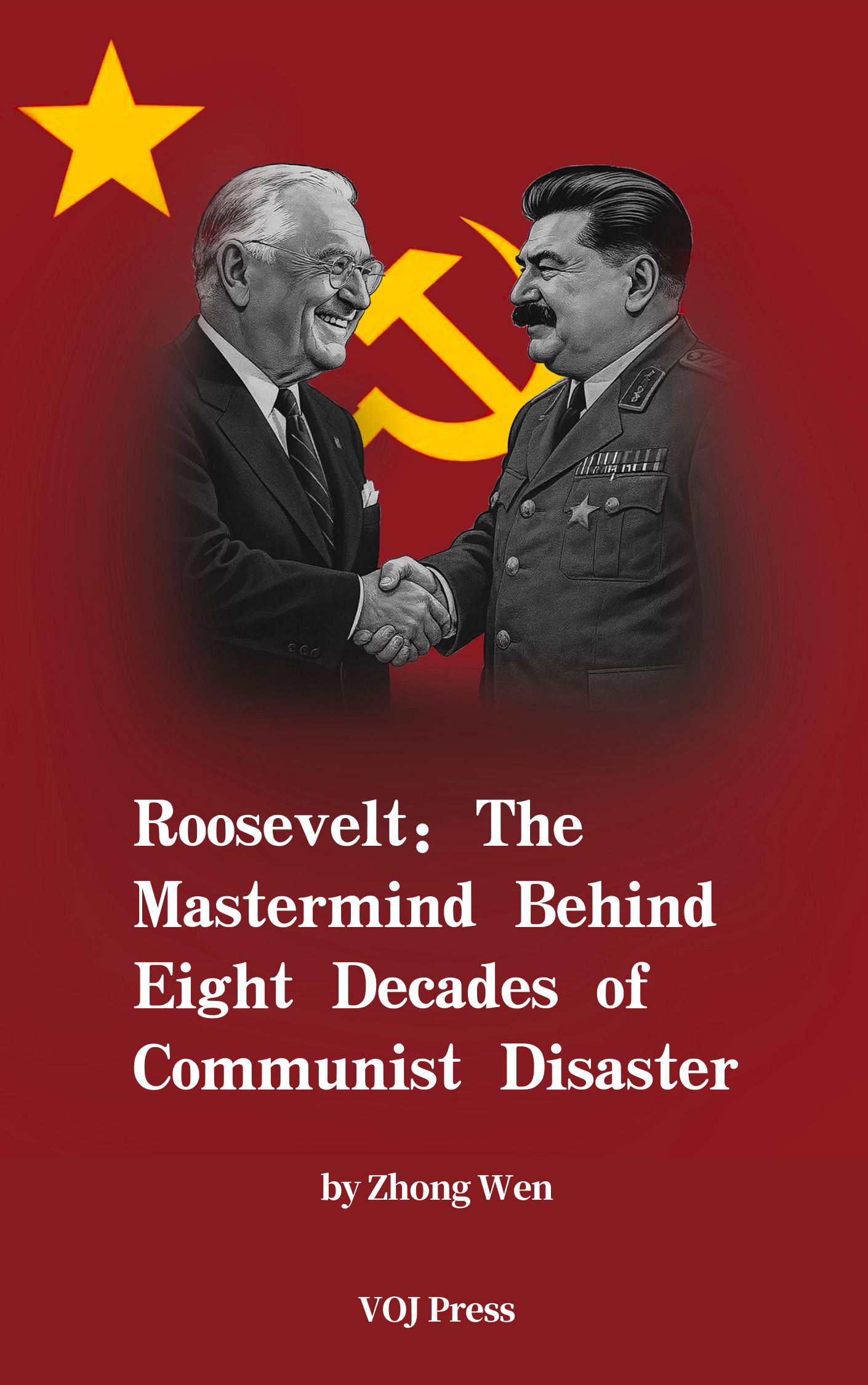
Chapter 12
Roosevelt Deceived Congress Even on His Deathbed
IV. Secret Correspondence Between Stalin and Roosevelt
Looking back at World War II, it’s hard to believe that the three Allied leaders — Britain, the United States, and the Soviet Union — only met face to face twice. In stark contrast, the frequent correspondence between U.S. President Franklin D. Roosevelt and Soviet leader Joseph Stalin was surprisingly extensive. Roosevelt even once told British Prime Minister Winston Churchill, ‘stalin treats me better than you do.” The two exchanged over a thousand letters. In 2010, a collection of 300 of these letters was made public for the first time, published in a book titled My Dear Mr. Stalin. These letters revealed the tensions, suspicions, and complexities among the three leaders.
Before the first meeting of the “Big Three” in Tehran in November 1943, Stalin had never left Soviet soil. Roosevelt tried to coax him into attending by writing persuasive and somewhat coercive letters.
Roosevelt wrote, “A 600-mile flight is not much—you know I’m flying more than ten times that distance. If the three of us can’t meet just because of a few hundred miles, future generations will see it as a tragedy.” Persuaded by Roosevelt’s appeal, Stalin finally agreed.
Roosevelt and Churchill departed from Cairo, Egypt, while Stalin flew out of Baku. According to the book, Stalin was terrified during the flight. His plane encountered turbulence over the Elburz Mountains in Iran, causing it to shake violently. Stalin gripped the armrests tightly, his face filled with fear.
All three elderly leaders later complained that the trip had nearly killed them. Stalin suffered earaches for two weeks; Roosevelt developed bronchitis after persistent coughing; Churchill came down with pneumonia.
It was Stalin’s first — and only — experience flying. When the Big Three planned to meet again in February 1945, Stalin absolutely refused to leave the Soviet Union. The other two leaders had no choice but to travel to the Black Sea resort town of Yalta in Crimea. There, they signed the famous Yalta Agreement — in which Stalin agreed to join the war against Japan in exchange for Outer Mongolia’s independence and the restoration of Russia’s rights in Northeast China to their 1904 pre-Russo-Japanese War status.
The book cites a 2003 U.S. intelligence publication, Intelligence Studies, which revealed that Stalin’s refusal to leave the USSR was for two additional reasons. First, it allowed him to install listening devices in the former Tsarist palace where Roosevelt and Churchill were staying. He could then record their private conversations and use the information to gain leverage in negotiations. Second, Stalin had once embarrassed himself at a banquet in Tehran — he didn’t know how to use a knife and fork, and had to be taught table etiquette by a translator, a deeply humiliating experience. Staying in the Soviet Union allowed him to avoid such discomfort.
During the war, communication among the Allies was limited to encrypted telegrams. To avoid German interception, face-to-face meetings were ideal. But since Stalin refused to leave his territory, they resorted to secret couriers carrying handwritten letters. By the time Roosevelt died in April 1945, the three leaders had exchanged over 2,500 letters — most of them between Roosevelt and Stalin.
According to The Guardian, these letters should not be read as literary works, but as historical documents. Both Roosevelt and Stalin reportedly saw letter-writing as a tedious chore — especially Stalin, for whom English was not a native language, making each letter difficult to compose. Yet the content of their correspondence reveals that Stalin’s requests to Roosevelt were often arbitrary and one-sided.
In one letter from October 1941, Roosevelt pledged to supply the Soviet Red Army with a constant stream of materials — including barbed wire, fur coats, and even military boots.
The Guardian humorously called it ‘the most expensive shopping list in modern history,” comprising 67 items. Item No. 6: 5,600 trucks immediately, followed by 10,000 per month. Item No. 23: 300 tons of ferrosilicon per month. Item No. 25: 1,000 tons of armor plate per month. Item No. 42: 2,000 tons of toluene for making explosives per month. Item No. 66: at least 200,000 pairs of military boots per month.
At the time, Hitler had already invaded the Soviet Union. Stalin replied to Roosevelt: “We are taking all necessary precautions to ensure cooperation with the United States in fighting our common enemy — murderous Nazism.”
Roosevelt remained optimistic about the war. In a letter to Stalin in June 1943, he wrote, ‘to achieve final victory, we need unity and a spirit of sacrifice. This spirit encourages us to take on the task of leading the world to peace.” He worked tirelessly to win Stalin over to the war against Japan—efforts that were viewed with suspicion by many Americans.
Roosevelt’s ambition for control became his greatest weakness. In 1941, he wrote to Churchill, “Frankly, I can handle Stalin better than I can deal with your Foreign Office or our State Department. Stalin despises your top officials for being timid. He believes he likes me more, and I hope he continues to feel that way.”
Churchill disagreed. He replied, ‘stalin is ruthless and heartless — there will be dire consequences in the future.” The Guardian noted that Churchill’s prediction turned out to be prophetic.
Two hours before Roosevelt died on April 11, 1945, he asked his aide to draft a letter to Stalin. Italy was on the verge of surrender, but the Soviet representative had been excluded from the negotiations, which infuriated Stalin. Roosevelt tried to explain: “We must not harbor mutual suspicions. Small misunderstandings like this must be avoided in the future.” While dictating the letter, Roosevelt complained of severe pain at the back of his head. Two hours later, he died. It was the price he paid for “dancing with wolves.”
The Guardian commented that Stalin showed his true colors after Roosevelt’s death, becoming openly hostile and distrustful toward Britain and the U.S., laying the groundwork for the Cold War. The report concluded that this batch of correspondence constitutes one of the most important archival collections of the 20th century.
At the time, only a handful of advisors knew about Roosevelt and Stalin’s secret communications. These letters remained sealed for 60 years—and now, finally, they have come to light.
Zhong Wen’s Note: On April 12, 1945, Roosevelt said, “I have a terrible headache.” That night, he died of a cerebral hemorrhage. Since then, the Communist Party has thanked the devil every day for sending them Roosevelt — who helped Stalin win WWII and build a socialist bloc to enslave hundreds of millions. Though Roosevelt is dead, the bitter fruits of his choices can never be undone.
 正义钟声 Voice of Justice