
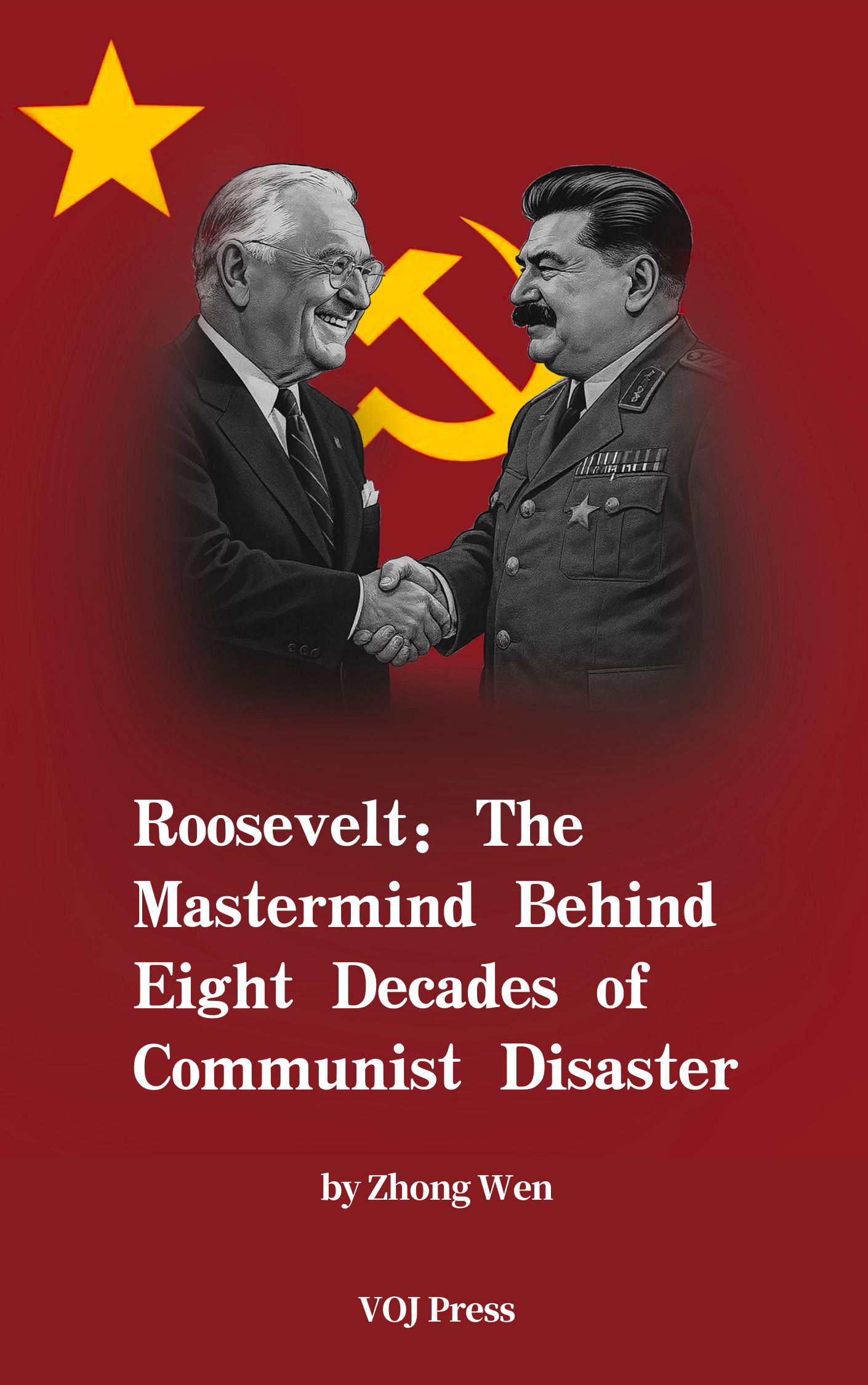
Roosevelt: The Mastermind Behind Eight Decades of Communist Disaster
Chapter 11
Roosevelt Risked His Life to Attend the Yalta Conference
After much difficulty, Roosevelt arrived in Yalta on February 3, 1945. He was carried off the plane and into a car by his aides, thoroughly disgracing the United States and truly bringing national humiliation. It was clear that this scheming man was completely exhausted: “His face looked terrible, covered in wrinkles, reflecting extreme fatigue. His skin was gray, almost translucent.” He was shivering from the cold, his expression dejected, like a shadow always on the brink of death.
I. Stalin’s Crocodile Tears
From February 4 to February 11, 1945, the Yalta Conference was held in Crimea, USSR, with Roosevelt, Churchill, and Stalin participating. The conference set the blueprint for the post–World War II world order and the division of power among major powers, forming the so-called “Yalta System,” which had a profound impact on the postwar world.
The conference covered issues such as the division of German occupation zones, Germany’s obligations, and the prosecution of major war criminals. It was the second major Allied leaders’ meeting after the 1943 Tehran Conference. Although some agreements were disputed later at the Potsdam Conference in July–August 1945, the Yalta Conference had lasting influence.
While historically significant, the Yalta Conference remains controversial. Though it gave Allied leaders an opportunity to shape the postwar world, several of its decisions sparked long-term debate:
The Fate of Eastern Europe: The conference placed Poland, Czechoslovakia, Hungary, Romania, and Bulgaria under Soviet influence, turning them into satellite states and depriving them of independence.
Division of Germany: Germany was divided into occupation zones managed by the US, UK, USSR, and France, sowing the seeds for Cold War tensions.
Punishment of Germans: War crimes trials were agreed upon, but this also raised the question of whether the German people as a whole were being punished.
Concessions to the USSR: To secure Soviet involvement in the war against Japan, the Allies agreed to cede Sakhalin and the Kuril Islands to the USSR — a major concession.
As for China, several arrangements negatively impacted its national interests:
Northeast Asia: The USSR was given control over China’s Northeastern and South Manchurian railways, harming Chinese sovereignty.
UN Security Council Seat: While China was promised a permanent seat on the UN Security Council to entice Soviet cooperation against Japan, this promise was not fully honored.
In sum, the Yalta Conference was historically important but heavily criticized due to its decisions and consequences.
After much difficulty, Roosevelt arrived in Yalta on February 3, 1945. He had to be carried from the plane into a car by his aides, thoroughly humiliating the United States. The scheming president was now utterly worn out: “His complexion was poor, full of wrinkles, reflecting extreme fatigue. His skin was gray and nearly translucent.” He trembled from the cold, looking dejected, like a mere shadow, constantly on the verge of death.
Churchill complained, “He no longer had the physical strength that his position required.” Others wondered, ‘should the President have stepped down before such a crucial conference? Did Churchill and Stalin take advantage of his illness?” The answer seems obvious. It was a misfortune for the American people to have elected such a compromised leader.
Roosevelt’s clouded mind manifested in two ways: first, in his obsession with being remembered as a peacemaker — to be recorded in history as “greater than Caesar, wiser than Socrates.” He repeated this nonsense endlessly. Second, it caused major misjudgments, particularly regarding Stalin. Roosevelt was captivated by Stalin’s sinister charisma, admired him, and believed Stalin admired him in return. In order to gain Stalin’s agreement, he was ready to make substantial concessions.
But the cunning Stalin even manipulated the lodging arrangements — he had Roosevelt’s and Churchill’s villas placed on either side of his own to force them to pass beneath his windows, making private US-UK conversations difficult. He also installed listening devices.
Roosevelt once fantasized about how to divide the postwar world: ‘the Far East belongs to Chiang Kai-shek, who, with our help, will rule China. The Pacific? That’s America’s. Africa? Britain’s… Europe? That belongs to Stalin. I only hope he won’t be too rough when he enters Europe.” Historians believe Roosevelt had by then completely lost clarity in foreign affairs. He followed vague principles rooted in delusion.
During the eight days of meetings, Roosevelt often seemed absent-minded, confused, unfocused, and even nodded off during sessions. Two months later, he died.
But before his death, he made an irreversible mistake that allowed the world to slip into a Cold War — and proxy hot wars — fueled by Soviet aggression.
In February 1945, when the Yalta Conference concluded, Stalin looked at the distant figure of Roosevelt being wheeled away and sighed aloud, “Why was fate so unfair to him?” Stalin was not one to show emotion easily.
In April 1945, just weeks after the conference, Roosevelt died. Upon hearing the news, Stalin actually shed tears. After a long silence, he remarked, “He must have been poisoned.” Stalin even called for an autopsy. But in reality, Stalin himself bore heavy responsibility for Roosevelt’s death — he had pressured the ailing, pro-Soviet Roosevelt to undertake the grueling journey to Yalta, and not long after returning to the US, Roosevelt passed away.
What if Roosevelt had been clear-minded at Yalta? What would the postwar world have looked like then?
 正义钟声 Voice of Justice