
Roosevelt: The Mastermind Behind Eight Decades of Communist Disaster
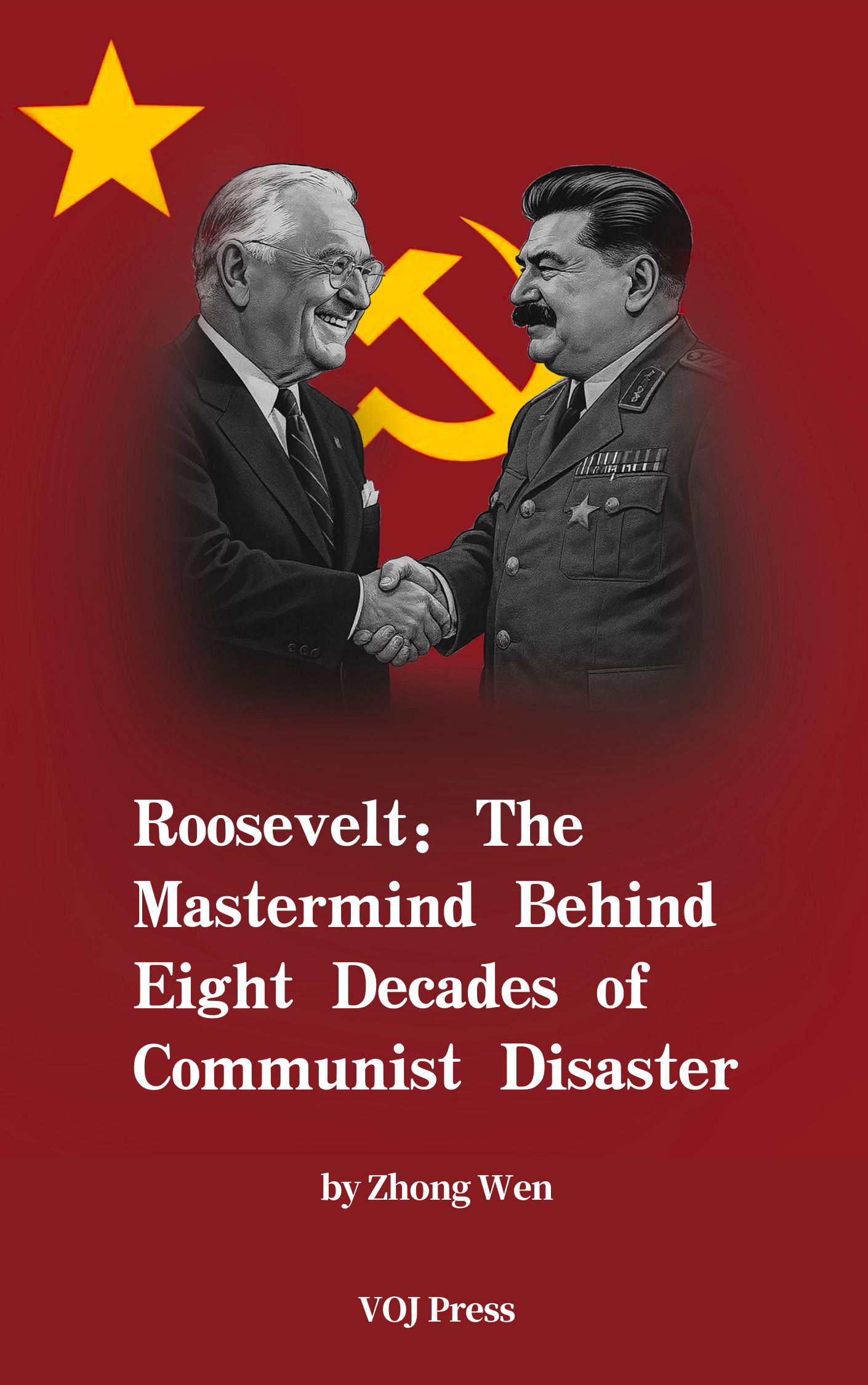
Chapter 10
Roosevelt’s Betrayal of China’s Sovereignty
Roosevelt colluded with the Soviet Union to divide China and gave away Outer Mongolia, secretly recognizing Soviet privileges in Northeast China as part of a deal for the Soviet Union to send troops into Northeast China. In fact, Roosevelt’s intelligence failed — he was completely unaware that Japan’s elite Kwantung Army had already been depleted during the Pacific War! From this perspective, Roosevelt was like Lucifer — the devil he unleashed still runs rampant in the world today! Eastern Europe became free in 1989, but in 2024 China remains enslaved.
I. The “Far East Munich” at Yalta
From February 4 to 11, 1945, the leaders of the United States, Britain, and the Soviet Union — Roosevelt, Churchill, and Stalin — held their second wartime meeting on the Crimean Peninsula in the Soviet Union, known as the Yalta Conference or Crimean Conference.
Without China’s knowledge, Roosevelt sold off a series of rights including Dalian and the Chinese Eastern Railway to the “devil” Soviet Union!
At the Yalta Conference, the three leaders primarily discussed the disposition of Germany and the redrawing of Poland’s borders — European issues. The agenda concerning China was of little interest to Churchill and was almost entirely decided between Roosevelt and Stalin. Their core focus was the conditions under which the Soviet Union would enter the war against Japan in Northeast China.
The Soviet Union’s demands for entering the war against Japan underwent a “lion’s greedy mouth” process of increasingly outrageous conditions.
In October 1943, Stalin told US Secretary of State Hull in Moscow that the Soviet Union “completely does not need you to ask” and “has no attached conditions’ to join the fight against Japan. Yet a month later at the Tehran Conference, Stalin proposed that the Soviets receive a warm-water port in the Far East after the war.
By October 1944, with Germany’s defeat all but certain, Stalin told visiting Churchill that besides increased aid to the Soviet Union from the US, ‘the political aspect of Russia’s participation in the war against Japan’ needed to be clarified.
At Yalta, the “devilish” Stalin finally revealed his hand, claiming he wanted to “recover what Japan took from Russia in the Russo-Japanese War” — exposing his cruel imperialist face!
During talks, Stalin first demanded the return of southern Sakhalin and the Kuril Islands, taken by Japan during the Russo-Japanese War. Roosevelt replied, ‘that will be no difficulty whatever.” Then Stalin raised the issue of a warm-water port in the Far East (referring to Dalian). Roosevelt said he “had not yet had the opportunity to discuss this with Marshal Chiang Kai-shek, so he could not speak on behalf of the Chinese,” but added that Russia’s use of the port could be achieved either (1) by directly leasing it from the Chinese, or (2) by making Dalian a free port under an international commission. Roosevelt favored the latter, effectively choosing a postwar management plan for Dalian on China’s behalf.
Stalin then demanded continued use of the South Manchuria Railway and the Chinese Eastern Railway after the war. Roosevelt said, “Although he had not yet discussed this with Marshal Chiang, there were two solutions: (1) lease the railways to the Soviet Union for direct operation; or (2) place them under a committee composed of one Chinese and one Russian.” After the Russo-Japanese War, Russia was forced to concede the South Manchuria Railway to Japan. After the ‘september 18 Incident,” the Soviet Union sold its joint rights in the Chinese Eastern Railway to the puppet Manchukuo government. Now the Soviets demanded to restore their postwar use of both railways and gained American approval. This became reality through the secret Yalta agreements.
Stalin explained the reason for these demands: “If these conditions cannot be met, neither I nor Molotov can explain to the Soviet people why Russia should join the war against Japan. They clearly understand the war against Germany was due to the threat to Soviet survival, but cannot understand why Russia should fight a country with which it has no major disputes.”
However, “if these political conditions are met, the people will understand that it concerns national interests, and it will be very easy to explain this decision to the Supreme Soviet.”
Roosevelt did not oppose these conditions. He said he “had not yet had a chance to speak with Marshal Chiang Kai-shek, and one difficulty in talking to the Chinese is that anything said would become known worldwide within 24 hours.”
In other words, the agreements that infringed on Chinese sovereignty did not need to be disclosed to China at that time. Stalin agreed, saying ‘there is no need to inform the Chinese yet, and he can guarantee the Supreme Soviet will keep it secret.” He hoped ‘these terms could be put into writing by the three powers.” Roosevelt immediately responded, ‘that can be done.”
As we know, the final Yalta agreements included stipulations that ‘the status of Outer Mongolia (the Mongolian People’s Republic) shall be maintained” and ‘the Soviet Union’s lease of the naval base at Lüshun (Port Arthur) shall be restored,” among a series of unequal treaties!
Although at America’s request the agreement added that ‘the consent of Chairman Chiang Kai-shek of China shall be sought regarding Outer Mongolia and the port and railway issues,” it also clarified that “according to Marshal Stalin’s proposal, the President of the United States will take steps to obtain this consent,” and that ‘the three leaders agreed that the Soviet demands must be fully implemented after Japan’s defeat.” — Clearly, China’s “right to consent” was hollow!
The secrecy was partly for military reasons — to prevent Japan from gaining intelligence and striking first against the thinly defended Soviet Far East. The other reason was political: if China knew the conditions for Soviet entry, Chiang Kai-shek would strongly oppose them, making the agreement impossible to implement.
Roosevelt believed the Yalta Agreement’s signing, in which the Soviet Union recognized the Chinese National Government and promised to “prepare to sign a Sino-Soviet friendship and alliance treaty to help China free itself from Japanese bondage with its military power,” would aid China’s democratization. Obviously, Roosevelt was dreaming an impossible, fevered dream.
Later, in the Sino-Soviet Treaty of Friendship and Alliance, it was further stipulated that ‘the Soviet government agrees to provide China with moral, military supplies, and other material aid, fully supporting the central government — the National Government.” Clearly, China’s fate was decided by these deeply flawed, incorrigible villains!
 正义钟声 Voice of Justice