
Roosevelt: The Mastermind Behind Eight Decades of Communist Disaster
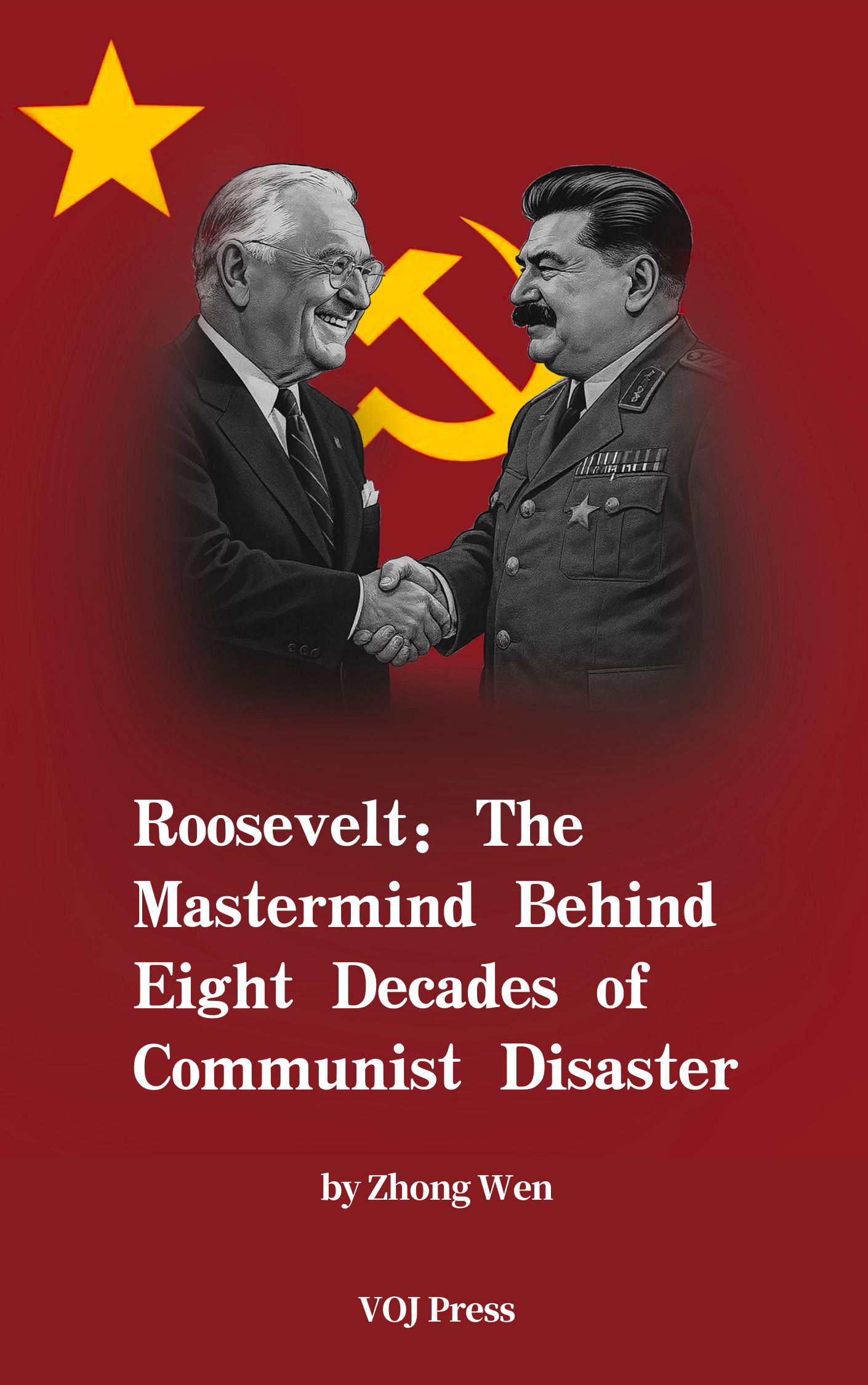
Chapter 09
Roosevelt is nothing but a Lucifer
V. The Devilish Soviet Army Sweeps Through Eastern Europe
The harsh reality of 1945: With the help of Britain and the United States, the Soviet army directly stormed Berlin, effectively occupying most of Eastern Europe. The Soviet army defeated the German forces on the Eastern Front through sheer human wave tactics and gained territory, cementing its dominant position as a fait accompli.
This achievement was realized with the strong cooperation of the Anglo-American “Normandy landing”. Due to the errors of Normandy, unless the British and Americans formed a joint army to confront the Soviets, Stalin would inevitably dominate Eastern Europe. In fact, those countries that fell into Stalin’s hands had no chance for free elections, only to accept Soviet tyranny.
Roosevelt, like Lucifer, allowed the Soviet Union to divide China and seize Outer Mongolia, recognizing Soviet privileges in Northeast China as part of the deal for the Soviet Union to send troops there. In reality, Roosevelt’s intelligence failed to recognize that Japan’s elite Kwantung Army had already been exhausted in the Pacific War!
As Lucifer, Roosevelt was portrayed by historians, his political opponents, and even his own aides as a cold, cunning, and vengeful politician. These judgments went beyond mere policy differences and also included personal criticisms. People’s eyes are sharp!
For example:
In March 1941, he pushed Congress to pass the Lend-Lease Act, enabling the United States to exchange 50 outdated destroyers for British naval bases in the Caribbean. This was actually a violation of the U.S. Constitution, since the Neutrality Acts required the government to remain neutral and that such treaties be mutually approved, not unilaterally decided. Roosevelt knowingly broke the rules, telling his aides privately, “I might be impeached for this.”
On December 7, 1941, the Japanese attacked Pearl Harbor. Although the U.S. government has never officially confirmed it, decrypted documents suggest Roosevelt may have had prior knowledge of the attack. To silence isolationists and rally public support for entering the war, he allowed the attack on U.S. soil to proceed. The attack resulted in 2,403 U.S. military deaths, 1,178 injuries, over a hundred civilian casualties, the sinking of four battleships and two destroyers, destruction of 188 airplanes, and extensive damage to buildings, ships, and aircraft.
In 1937, during Roosevelt’s New Deal, the Labor Law faced opposition from the conservative Supreme Court. Roosevelt attempted to pack the court secretly to dilute the number of justices and ensure his legislation passed.
To implement his radical New Deal and lead the U.S. into World War II, Roosevelt broke the precedent set by Washington of only serving two presidential terms, unprecedentedly winning four terms. In elections, he suppressed and excluded colleagues within the Democratic Party, showing no mercy even to former mentors, comrades, and subordinates.
Conservative critics say Roosevelt’s “crimes” went beyond the above. He was the first to assert housing, healthcare, and education as American rights. For example, his “Veterans’ Rights Act” gave many benefits to World War II veterans. Critics argue Roosevelt used his office to buy votes, ushering in an era of career politicians and growing national debt.
Moreover, the New Deal never brought unemployment below 8%, and the economic crisis was only truly resolved by the war. Due to the war, the military-industrial complex (a term coined by Eisenhower) emerged, proving to be a lasting and dominant force.
Perhaps because of this, Roosevelt saw in Stalin a kindred spirit — both were rising powers breaking through barriers, young and vigorous nations, unlike the old, fading empires. Roosevelt’s New Deal — with its Keynesianism, big government, and welfare state concepts — while not identical to Stalin’s state-run economy, bore some resemblance. Incidentally, Stalin also had physical disabilities — smallpox in childhood left him with a pockmarked face, a deformed left arm, and a slight limp. Both men were secretive, self-righteous, and ruthless.
Looking at the world stage, Roosevelt saw a once-in-a-century opportunity: the U.S. and Russia could act as the western and eastern lines of European colonialism, encircling Europe and dividing Asia, overturning the international chessboard. According to zero-sum game theory, winners always mean losers. Stalin certainly had the same intention. They met late but instantly bonded; these two devils, who resonated deeply, could only be understood and not explained. Historically, only the handshake between Mao Zedong and Nixon nearly 30 years later could be compared, both changing the world order.
Thus, Roosevelt was indeed a Lucifer — releasing devils who still roam the world today!
 正义钟声 Voice of Justice