
Roosevelt: The Mastermind Behind Eight Decades of Communist Disaster
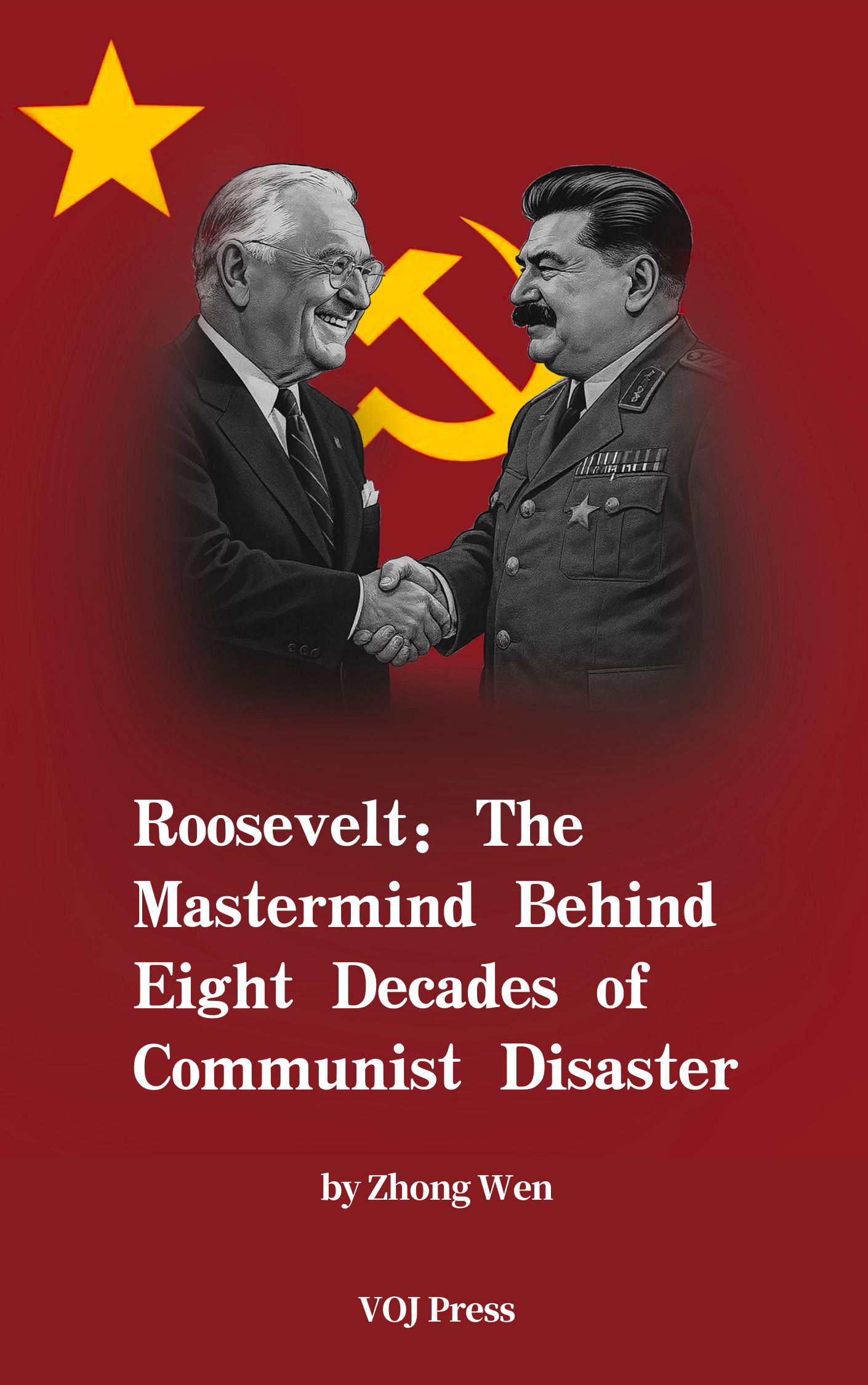
Chapter 09
Roosevelt is nothing but a Lucifer
IV. Roosevelt and Churchill Betrayed the Freedom of the Eastern European People
In November 1943 in Tehran, Roosevelt met with the leaders of the Soviet Union and the British colonial empire. Churchill, on behalf of King George VI, flattered Stalin by showing him a sword engraved with the words ‘stalingrad.” Meanwhile, Stalin was grateful toward America, represented by Roosevelt. At the banquet, Stalin raised his glass and praised, “Without these machines from America (his exact words), we would not have won this war!” By June 1944, when meeting with the president of the American Chamber of Commerce, Stalin said, “If I were born in America, I would be an industrialist.” It was America’s massive aid that prolonged the Communist regime’s life!
From Churchill’s point of view, Roosevelt trusted Stalin too much — like an inexperienced sophomore, acting frivolously and naively. But Churchill, well-versed in European geopolitics and experienced in managing an empire for centuries, clearly understood Stalin’s true intentions: first, Stalin was a revolutionary Communist, an ideological mortal enemy. A weasel paying respects to a chicken — what good could it mean? Second, Stalin represented Russia — a country that could never truly enter European civilization and never free itself from barbarism and tyranny.
In Roosevelt’s eyes, Churchill was an Anglo elite ruling the world, but “an old, worn-out warrior.” He embodied the scheming cunning of a 19th-century politician, constantly fussing over tactical details and playing petty tricks, but lacked the strategic vision needed for the 20th century. Roosevelt believed Churchill’s actions and thoughts were only aimed at preserving the outdated vested interests of the British Empire.
In theory, the US and UK were like brothers and should have cooperated closely. At first, Churchill laughed at Roosevelt’s flattery of Stalin, but later he could no longer laugh. Churchill realized that the rise of Soviet and American power would diminish Britain’s position during and after the war. His fears were justified. During the first two years of the war, Britain had more anti-German troops on the battlefield and thus held the dominant position in the Anglo-American partnership. But by November 1943, when the “Big Three” — Roosevelt, Churchill, and Stalin — met in Tehran to carve up the world, the positions had reversed, and the US was set to play the leading role in the European theater.
Moreover, it had become clear that not only could the Soviet Union survive the war, but its role in the postwar world would be crucial. Roosevelt repeatedly signaled to Stalin that the US and UK would not secretly plot against the Soviet Union. He deliberately cultivated a special bilateral relationship with Stalin at Tehran, independent of his original firm ties with Churchill.
At Tehran, Roosevelt sought private meetings with Stalin multiple times, while avoiding private discussions with Churchill. He openly disagreed with Churchill in front of Stalin — for example, rejecting Churchill’s proposals to strengthen Anglo-American joint operations in Italy and the eastern Mediterranean. Instead, Roosevelt and Stalin reached consensus that the Allies should focus on the 1944 Normandy invasion, which would help the Soviet forces on the Eastern Front gain breathing room.
Foolish Roosevelt thus sacrificed many American lives to sustain the dying Soviet regime, allowing this “red vampire” to live another fifty years, leading to the fall of Eastern Europe and East Asia and triggering a Cold War that plagued the world for over forty years.
Roosevelt, described here as ‘syphilitic and confused,” clearly “nurtured a tiger that would eventually devour him.” Yet this “Lucifer” was arrogantly confident that he could deal or “wrestle” with both communism and imperialism — only to be ultimately consumed by his own pride.
Roosevelt bore neither the historical burdens of Churchill’s empire nor the psychological pressures of Stalin’s besieged regime. During the conference, to ease tensions, he often joked with Churchill — saying things like, “Last night Winston didn’t sleep well; he got up on the wrong side of the bed this morning.” Even the stern Stalin sometimes secretly laughed. When the three were together, Roosevelt often teased Stalin at Churchill’s expense, which occasionally irritated Churchill. They would then reconcile privately. Behind their backs, Roosevelt and Churchill both called Stalin “Uncle Joe”, provoking a mock displeasure from Stalin.
These were all men possessed by demons, drinking from the blood of frontline soldiers while laughing heartily.
Through this playful interaction, Roosevelt fancied that his personal charm could soften and win over Stalin to jointly oppose Churchill if necessary — like a trio of schoolboys forming a “gang” that ruled over the rest of the class. Within this gang, there were still subtleties about who was aligned with whom and who was the real leader. Stalin understood this tacitly and cooperated. The choice of Roosevelt as chair of the conference — always seated in the middle during the official “Big Three” photo — expressed this sentiment perfectly.
Yet behind the scenes, Stalin was stealing from the American treasury, executing a “larger version” of the bank robberies he committed in his youth.
Roosevelt thought Stalin was physically strong, with large hands like a baseball player’s, and eyes shining golden like honey. This was certainly not the cold steel glare that class enemies claimed to see in Stalin’s eyes. Still, Roosevelt truly had some skill, briefly opening a window into Stalin’s tightly closed soul.
In February 1945, the “Big Three” met again at Yalta — Roosevelt’s second and last meeting with Stalin. The European war was nearing victory for the Allies, but Japanese forces were still stubbornly resisting in the Far East, making an invasion of Japan’s homeland inevitable. Roosevelt’s health was failing rapidly; he was near death. Yet at Yalta, Roosevelt basically got his way, securing Soviet acceptance of the United Nations’ principles and a promise from Stalin that the USSR would enter the war against Japan within three months of Germany’s surrender. (Roosevelt was unaware that the Japanese military was already severely depleted.)
Later, especially among Republicans, Roosevelt was accused of betraying Eastern Europe, leading to the “Iron Curtain” and decades of East-West division. In reality, at Yalta, the Big Three signed the European Liberation Declaration and a statement on Poland affirming that all peoples of former German-occupied areas had the right to choose their governments freely by secret ballot. But undeniably, the UK and US agreed to Stalin’s redrawing of Poland’s borders — allowing Soviet annexation of eastern Poland and shifting Poland’s western border westward at Germany’s expense as compensation. They also failed to insist on restoring the independence of the Baltic states, which had been ‘sovietized” following the 1939 Soviet-German non-aggression pact.
Thus, Roosevelt, together with Churchill, sold out the freedom of the Eastern European peoples.
 正义钟声 Voice of Justice