
Roosevelt: The Mastermind Behind Eight Decades of Communist Disaster
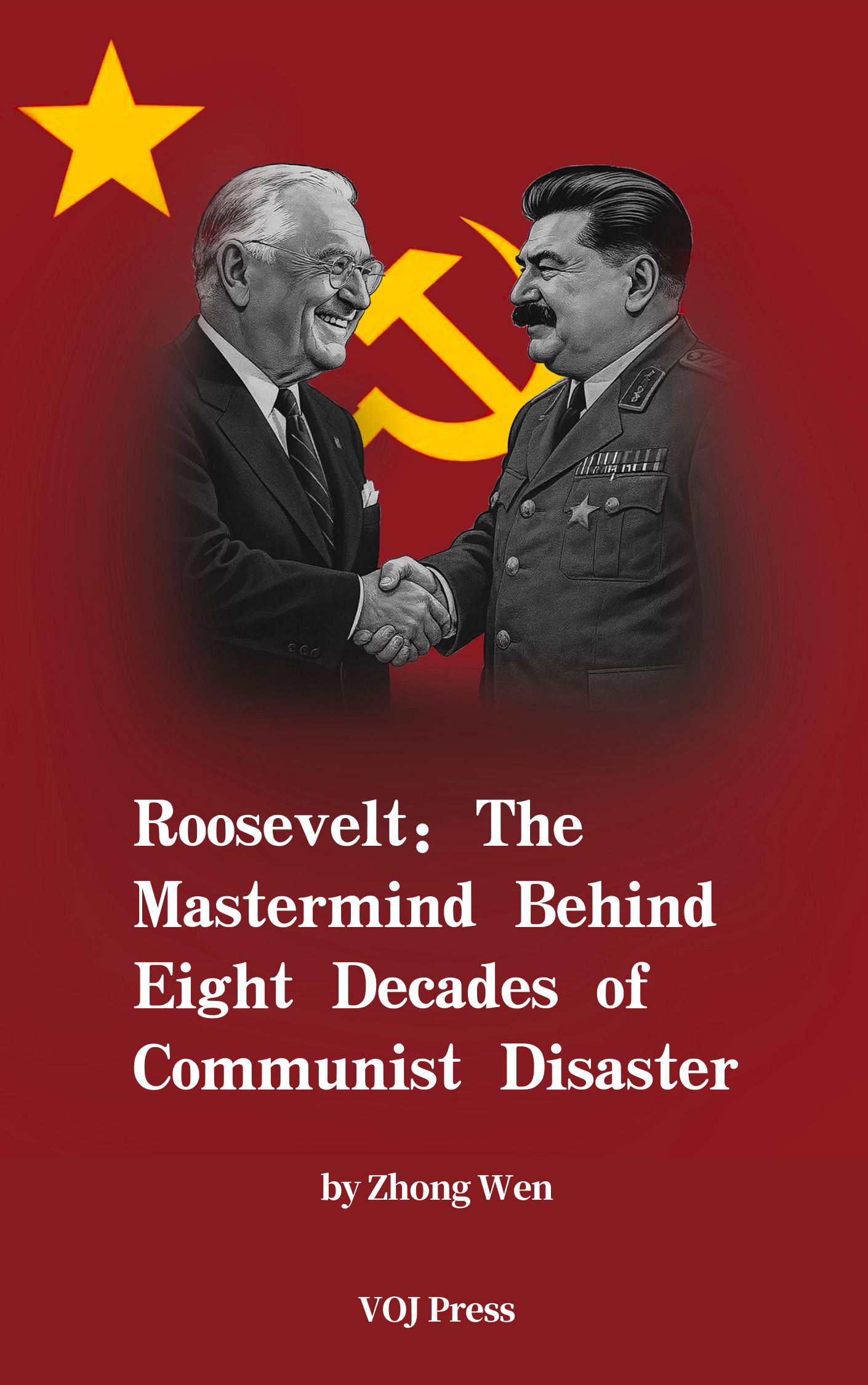
Chapter 09
Roosevelt is nothing but a Lucifer
III. Secret Deals at the Tehran Conference
The core issue at the Tehran Conference remained the opening of a second front. Churchill still had reservations about Operation Overlord, spending much time discussing other regions — Turkey, Greece, Yugoslavia, and Italy. Stalin was very straightforward; he showed no interest in those areas. Instead, he formally committed that once Germany was defeated, the Soviet Union would reinforce its forces in Siberia and launch an offensive against Japan. Roosevelt insisted on adhering to the deadline set at the Quebec Conference (May 1944). After Roosevelt expressed his position, Stalin glanced at Churchill, seemingly asking, “Well, what do you think?”
Next, Stalin asked a sensitive question: who would command Operation Overlord? Roosevelt was somewhat caught off guard. At that time, Churchill no longer insisted that Brooke or any other British general should be the overall commander, so both the British and American sides tended to favor Army Chief of Staff Marshall for the role. Roosevelt did not mention Marshall’s name directly, stating that no final decision had been made yet. Stalin did not mince words either; he said, ‘then there will be no good outcome. Someone must be responsible, someone must make decisions!”
Churchill took various measures to continue advocating his position: the Mediterranean could not be ignored. He seized every possible opportunity to raise the issue. Stalin acknowledged that the Mediterranean held some value but insisted it could not interfere with the implementation of Operation Overlord. The two clashed repeatedly, and in frustration Stalin retorted, “Do the British really believe Operation Overlord will succeed, or are they just saying so to reassure us?”
Churchill was angered; he took several deep puffs from his cigar and then proposed that the military staff discuss the necessity of the Mediterranean plan. Stalin challenged again: “Why leave this to military staff? We are government leaders; we know what we need! Why should subordinates tell us what to do?”
The atmosphere grew very tense. Roosevelt timely announced a recess. That evening, Hopkins visited Churchill at the British Embassy. He advised Churchill not to continue fighting over this issue. Roosevelt had already decided that Operation Overlord would be launched in May 1944, and the Russians were equally firm in their stance; the situation could not be changed. Hopkins suggested Churchill make concessions.
Whether Hopkins was acting on Roosevelt’s instructions or how much effect his visit had is unclear. At the next day’s meeting, the British side announced acceptance of the Overlord plan. Stalin immediately promised that during Operation Overlord, the Soviet army would launch a major offensive on the Eastern Front to prevent the Germans from transferring any divisions to the Western Front.
Secretary of War Stimson later recalled, “It was thanks to Stalin that the meeting was saved that day. It was precisely his frankness and determined arguments that prevented Churchill’s distracting plans from succeeding. I greatly admired his courage.” Not only Stimson, but Stalin’s performance at the Tehran Conference also earned the “respect” of Roosevelt and others.
On November 30, 1943, Churchill’s 69th birthday, the British Embassy hosted a grand banquet. The entire evening was filled with a relaxed atmosphere, sweeping away the tension of the previous days. Churchill wrote in his memoirs: ‘this was a moment to remember in my life. On my right sat Roosevelt, on my left Stalin. The three of us together controlled almost all the naval power in the world, nearly three-quarters of the air power, and commanded 20 million troops engaged in one of the most brutal wars in human history.”
Churchill and Stalin joked: “England is turning pink.” Stalin responded, ‘that means she is healthy.” Churchill then said, ‘to the Bolsheviks.” Stalin replied, ‘to the Conservatives.” At last, they were birds of a feather.
Unconsciously, Roosevelt had begun calling Stalin “Uncle Joe”. After Churchill raised his glass for a toast, Stalin wished to add another speech dedicated to the American president and people: “I want to tell you, from a Russian perspective, what President Roosevelt and the United States have contributed to this war effort. The most important thing in this war is weapons. The United States has proven it can produce 10,000 planes a month, while Russia can only produce 3,000. The United States is a nation of machines. Without the lend-lease program providing those machines, we would have lost this war.”
Stalin’s unexpected words of praise for American aid deeply moved Roosevelt. Roosevelt also asked to say a few words, in which he compared the anti-fascist alliance to a rainbow composed of many colors: “Each has its own characteristics, but together they form a wonderful whole. Therefore, although our countries have different customs, philosophies, and ways of life, we proved in Tehran that different national ideas can form a harmonious whole, united in dedication to the bright future of our nations and the world.”
In fact, Roosevelt’s approach faced strong resistance at home. The reasons were as follows: If the Soviet Union collapsed immediately, all those military supplies would fall into German hands. Britain still urgently needed aid in the summer and autumn of 1941; the situation in the Far East was also not optimistic and required sufficient resources just in case; Roosevelt also needed to strengthen the defense of the American homeland. Not to mention the public’s anti-communist sentiment and accusations from isolationists that Roosevelt was supporting the Soviet Union and trying to drag the United States into the European war.
Despite heavy opposition, Roosevelt insisted on his belief: the longer the Soviet Union could hold the Nazis on the Eastern Front, the more likely the Anglo-American allies could turn the tide of the war. As soon as the war broke out, he told an aide: Germany’s attack on Russia was not just a temporary shift in the war’s focus; it might mean “Europe’s liberation from Nazi hands.”
With the attack on Pearl Harbor on December 7, 1941, the United States directly entered World War II, and Americans themselves began to suffer casualties on the battlefield. This made Roosevelt’s desire to turn Stalin from an enemy into a friend more clear and urgent. He took a two-pronged approach in both military and diplomatic arenas: in 1942, the United States opened the ‘second front” in North Africa to relieve German pressure on Russia on the Eastern Front. At the Casablanca Conference in January 1943, Roosevelt announced that the Allies would only accept the Axis powers’ “unconditional surrender.” This was a clear signal to the Soviet Union: the Allies would not abandon the USSR but instead bind it closely to the Allied cause.
Recognizing the Soviet Union’s critical role in the war — where the Soviet military ultimately sacrificed more than eight million soldiers on the extremely brutal Eastern Front — and understanding that US-Soviet relations would be the foundation of postwar global stability, Roosevelt deliberately cultivated his personal relationship with Stalin. Besides sending a trusted personal representative to Moscow to meet Stalin shortly after Germany invaded the Soviet Union in the summer of 1941, Roosevelt also proactively proposed in October of the same year that the two heads of state should meet as soon as possible.
Now let’s take a closer look at Stalin — the man and his deeds:
Unlike Roosevelt, who was born with a silver spoon in his mouth, Stalin was born into a poor family in Tsarist Georgia and received only an Eastern Orthodox school education. In his early years, he robbed banks and obtained a large sum of money equivalent to about $1.4 million today. This habitual criminal was arrested seven times and exiled six times. Later, Stalin opportunistically joined the revolution, following Lenin-led Bolsheviks. His work running the party newspaper Pravda and helping Lenin escape abroad drew attention and led to his promotion.
Stalin’s original name was Joseph Vissarionovich Jughashvili. As a criminal, he used the alias ‘stalin”, meaning “man of steel”, though in reality he was cowardly and cunning. Due to Stalin’s crude and brutal methods, Lenin had once suggested removing him from the position of General Secretary. However, after Lenin’s death, Stalin gradually seized control of the Party and the government, purging his internal opponents, including Trotsky, whom Lenin had favored.
Once his power was consolidated, Stalin immediately pushed forward the planned economy with full force through the “Five-Year Plans”: socialist industrialization and rural collectivization. He aimed to transform the Soviet Union from an agricultural country into an industrial one, turning a nation that imported machines and equipment into a country producing them, prioritizing heavy industry. Although the Soviet Union rapidly industrialized in the 1930s and became Europe’s largest industrial power, this came at the expense of the peasants’ interests. Agriculture stagnated for a long time, and a massive famine struck, especially in Ukraine.
Now, a hundred years later, Russia still has not become a major machine-exporting country and remains technologically and industrially backward. Yet during the Great Depression a century ago, many Western leftists, disillusioned with their own societies, looked with hopeful eyes toward the Soviet Union. This caused left-wing ideology to spread globally at that time. As a result, Roosevelt’s administration and his advisors were also deeply influenced by these currents.
In July 1934, the British writer H.G. Wells conducted an exclusive interview with Stalin. Contrary to the nonsense found in The History of the Communist Party of the Soviet Union, Stalin clearly advocated class struggle, violent revolution, and the dictatorship of the proletariat, firmly rejecting the parliamentary path of Western societies. However, he gave quite high praise to Roosevelt’s “ability, talent, and courage.” That said, Stalin believed Roosevelt’s efforts were in vain — his reformism could not save the dying capitalism.
But on June 22, 1941, Nazi Germany launched a blitzkrieg against the Soviet ally. This completely took Stalin by surprise. Shocked, he disappeared from the public eye for nearly two weeks. Although Stalin seriously misjudged the situation, the Party and government leadership, cowering before his purges, still “earnestly begged him to continue leading.”
 正义钟声 Voice of Justice