
Roosevelt: The Mastermind Behind Eight Decades of Communist Disaster
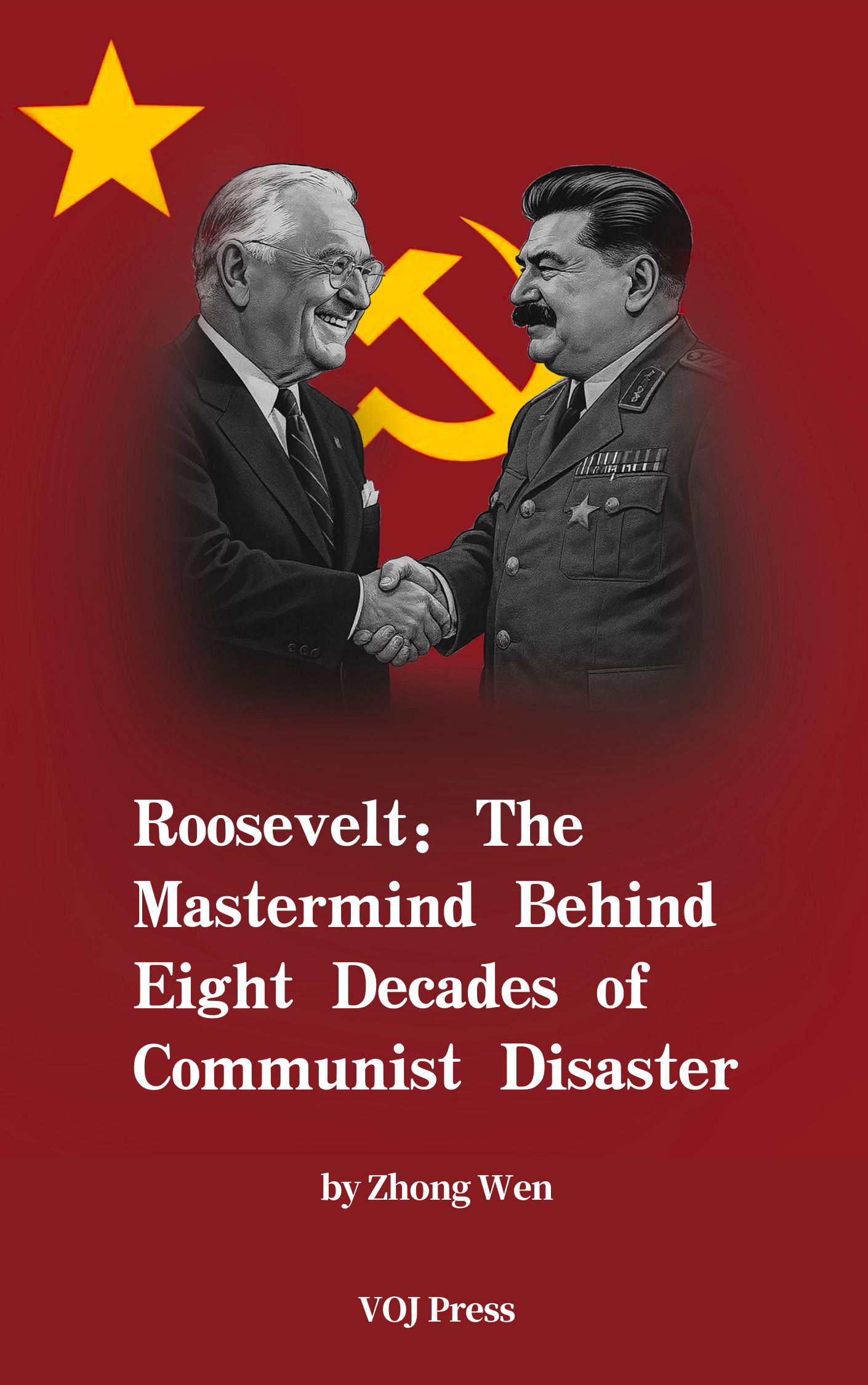
Chapter 09
Roosevelt is nothing but a Lucifer
Roosevelt, in collusion with Churchill, betrayed the freedom of the peoples of Eastern Europe! Looking across the globe, Roosevelt saw a once-in-a-century golden opportunity: the United States, together with Russia, could serve as the western and eastern fronts of European colonialism, encircling Europe from both sides and converging in Asia, thus overturning the global chessboard. According to zero-sum game theory, where there are winners, there must also be losers. Stalin clearly shared the same vision. It was a meeting of like minds, a late but fateful encounter between two devils — drawn to each other in mutual understanding beyond words. Historically, only one other event compares: nearly thirty years later, when Mao Zedong and Richard Nixon — the two thieves — shook hands, an act that also reshaped the global order.
I. Roosevelt and Stalin: A Cozy Relationship
Tracing back to November 1943, the first meeting of the “Big Three” — the U.S., the U.K., and the Soviet Union — was held in Tehran. It was the first time Roosevelt and Stalin met face to face.
Both the Soviet Union and the United Kingdom had extended invitations to Roosevelt to stay at their respective embassies. However, in order to avoid showing favoritism, Roosevelt chose to stay at the American legation. Due to Roosevelt’s physical limitations, Soviet Foreign Minister Molotov suggested that the meetings be held at the American mission.
But that very afternoon, Molotov urgently summoned the U.S. and British ambassadors to the Soviet Union and informed them: “According to Soviet intelligence intercepts, Hitler is planning to eliminate all three leaders during their gathering.” Molotov added, ‘the agents have parachuted in; some have already been captured, but several are still at large.”
Thus, the Soviet side proposed once again that Roosevelt should relocate to either the Soviet or British embassy for safety.
The Americans believed that this intelligence was largely fabricated — or at least exaggerated — by the Soviets. However, considering that the U.S. legation was located on the opposite side of Tehran, a considerable distance from the Soviet and British embassies, the Americans reluctantly agreed to Roosevelt’s relocation. On the one hand, they did not want to bear responsibility should anything happen; on the other, they didn’t want to give the impression that they were disregarding the safety of Stalin and Churchill.
Since the Soviet embassy was heavily guarded with thousands of security personnel and was located close to the British embassy, the Soviets proposed that Roosevelt move into the official residence within the Soviet compound. Naturally, this arrangement was most advantageous to the Soviets: Stalin wouldn’t need to leave his own premises, and the Soviets would also be in an ideal position to gather intelligence on the Americans.
Roosevelt’s security personnel and aides were clearly wary of this arrangement. It would effectively place the President “entirely in Soviet hands,” and any discussions he had with his advisors could be easily monitored by the Soviets. Churchill, upon hearing the news, scoffed at the idea. But to everyone’s surprise, Roosevelt gladly accepted the invitation and moved into the Soviet embassy in Iran — becoming, in effect, Stalin’s “prized captive.”
Roosevelt acted on a sudden impulse, and in Churchill’s eyes, like a fool, willingly threw himself into the arms of the communists. But perhaps this was no accident — it suited Roosevelt’s questionable record all too well.
As soon as Roosevelt took office, he recognized the Soviet Union and even helped it achieve industrialization during the 1930s. This was despite the fact that, during the same period, Stalin was violently enforcing collectivization in the countryside and carrying out an unprecedented “Great Purge” across the party, government, and military. In August 1939, the Soviet Union even signed a “non-aggression pact” with Nazi Germany. Yet Roosevelt was careful not to completely close the door on the Soviets.
On June 22, 1941, Hitler launched a surprise attack on the Soviet Union, codenamed Operation Barbarossa. Around five million troops, 3,600 tanks, 2,700 aircraft, and 7,000 artillery pieces were mobilized — making it the largest military operation in European history. Most of Roosevelt’s advisers predicted that the Soviet Union would collapse within a few months. But Roosevelt thought otherwise. Within two days, he ordered emergency aid to the Soviets. Soon after, he sent his close confidant Harry Hopkins to Moscow to meet with Stalin and assess the situation on the ground. At home, Roosevelt lobbied Congress to extend the Lend-Lease Act to the Soviet Union — just as it had been applied to Britain — providing generous military support.
Roosevelt, like Lucifer, was poisoned by the devil and became a fellow traveler of international communism!
Lucifer (English: Lucifer, Latin: Lucifer, Italian: Lucifero) is a figure from religious legend. Lucifer is Satan before his fall. After his fall, he becomes Satan and will ultimately face eternal destruction.
Lucifer’s problem was excessive pride. This pride represents the true beginning of evil in the universe — just like the fall of Adam, the ancestor of mankind.
The Bible records:
Luke 10:18 — He replied, “I saw Satan fall like lightning from heaven.”
Isaiah 14:12 — How you have fallen from heaven, morning star, son of the dawn! You have been cast down to the earth, you who once laid low the nations!
Isaiah 14:13 — You said in your heart, “I will ascend to the heavens; I will raise my throne above the stars of God; I will sit enthroned on the mount of assembly, on the utmost heights of Mount Zaphon.”
Isaiah 14:14 — “I will ascend above the tops of the clouds; I will make myself like the Most High.”
Revelation 12:3 — Then another sign appeared in heaven: an enormous red dragon with seven heads and ten horns and seven crowns on its heads.
Revelation 12:4 — Its tail swept a third of the stars out of the sky and flung them to the earth.
Revelation 12:7 — Then war broke out in heaven. Michael and his angels fought against the dragon, and the dragon and his angels fought back.
Revelation 12:8 — But he was not strong enough, and they lost their place in heaven.
Revelation 12:9 — The great dragon was hurled down—that ancient serpent called the devil, or Satan, who leads the whole world astray. He was hurled to the earth, and his angels with him.
Revelation 20:2 — He seized the dragon, that ancient serpent, who is the devil, or Satan, and bound him for a thousand years.
Revelation 20:3 — He threw him into the Abyss, and locked and sealed it over him, to keep him from deceiving the nations anymore until the thousand years were ended. After that, he must be set free for a short time.
In early Greek Christian theology, Evagrius Ponticus, a monk, identified eight evil thoughts that damage the soul: gluttony, lust, greed, wrath, sloth, sorrow, vainglory, and pride. In the late 6th century, Pope Gregory I revised them into seven deadly sins: he merged sorrow into sloth and vainglory into pride, and added envy. His order was based on how severely each sin violates love. The sequence became: pride, envy, wrath, sloth, greed, lust, and gluttony.
Later theologians, like St. Thomas Aquinas, had different classifications, suggesting sins such as tyranny, cruelty, corruption, bribery, violence, lechery, and servility.
 正义钟声 Voice of Justice