
Roosevelt: The Mastermind Behind Eight Decades of Communist Disaster
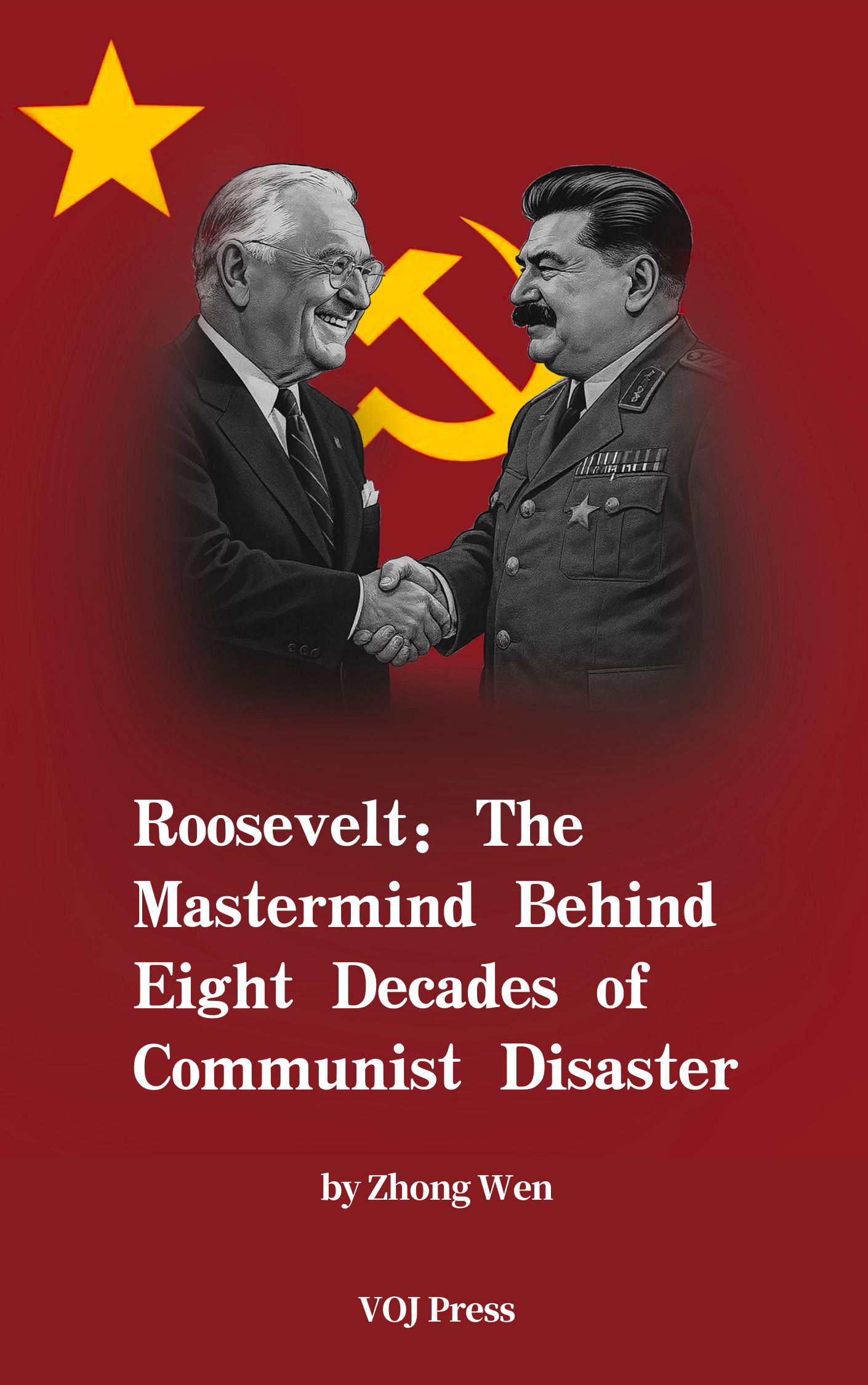
Chapter 06
Roosevelt’s Appeasement of Communism — Always Compliant with Soviet Demands
The bribes from the Soviet Union to the Roosevelt family were likely far greater than what has been publicly exposed. Otherwise, how could Soviet influence have so deeply shaped American foreign policy? A similar pattern emerged decades later in the U.S. “China policy” — people began noticing that the Clinton, Bush, Obama, Trump, and Biden families all had business ties with mainland China. This uncanny resemblance across time is not merely a historical coincidence, but rather a reflection of a recurring pattern in global politics.
I. Roosevelt’s Promise of Peace
The United States had paid a heavy price for its involvement in World War I. In the aftermath, isolationism and non-interventionism gained widespread support throughout the 1920s and 1930s. Against this backdrop, as wars reignited across Europe in the 1930s, Congress passed a series of Neutrality Acts designed to prohibit U.S. involvement in foreign conflicts.
Thus, during the 1940 presidential campaign, Roosevelt repeatedly promised not to drag the U.S. into another war. At campaign rallies, he declared: “I have said this before, and I shall say it again and again: Your boys are not going to be sent into any foreign wars.” However, Roosevelt also made it clear that the U.S. would provide material support to Britain in its fight against Germany. To justify this, he introduced the slogan ‘the Arsenal of Democracy”, asserting that the United States must become the industrial backbone of the free world. On December 29, 1940, in a nationwide radio broadcast, Roosevelt formally presented this slogan — a rhetorical mask to obscure his true intentions of sending Americans to die in war.
A review of the origins and evolution of the Lend-Lease Act reveals a troubling shift: what began as ‘support for democratic Britain” eventually morphed into ‘support for Soviet tyranny.” In July 1940, Britain suffered severe naval losses — within ten days, eleven destroyers were sunk by the German navy. The newly appointed British Prime Minister, Winston Churchill, urgently requested assistance from President Roosevelt. Roosevelt responded by offering 50 U.S. destroyers to Britain in exchange for 99-year leases on British naval bases in the Caribbean and Newfoundland. This decision sparked a major foreign policy debate in the United States: Should America aid Britain? Should it maintain strict neutrality? The intense national discussion that followed ultimately paved the way for the passage of the Lend-Lease Act — a law that would later be used not only to support democratic allies, but also to supply the totalitarian Soviet regime.
In January 1941, while still claiming to uphold his campaign promise not to involve the U.S. in foreign wars, President Franklin D. Roosevelt proposed a new plan to militarily aid America’s allies. After two months of heated debate, Congress ultimately passed the proposal — the Lend-Lease Act. The implementation of the Lend-Lease Act effectively nullified all previous Neutrality Acts passed by Congress in the 1930s. In response, Republican Senator Robert Taft — a leading opponent of the bill — warned that it would “give the President the power to wage an undeclared war anywhere in the world.”
That is exactly what happened. But the reality went even further — the Lend-Lease Act was soon used to support the Soviet Communist regime, Hitler’s former accomplice. The result? ‘stalin made outrageous demands, and Roosevelt — crippled and compliant — granted them all.” Stalin’s war against Hitler was a dog-eat-dog conflict, not a war fought on behalf of the United States — so why was America giving away weapons for free?
Stalin submitted a massive list of military demands: 15,000 aircraft, 7,500 tanks, and more …… Roosevelt agreed to everything — whatever Stalin asked, Roosevelt granted. He immediately mobilized five shipping routes, rushing supplies to the Soviet Union day and night. Within just two years, the U.S. had delivered all the requested military goods and war materials — a total amount equivalent to the entire U.S. military supply in 1944, and in today’s terms, worth over $1.5 trillion USD (adjusted to 70 years later).
Roosevelt played a disgracefully vital role in enabling the rise of the Soviet Union and the fall of Eastern Europe and East Asia. Was this the result of Roosevelt’s syphilitic madness, or simply the evil nature of Lucifer himself?
Historically, it seems that the United States and the Soviet Union became mortal enemies after World War II. Churchill’s famous Iron Curtain speech formally launched the Cold War, dividing the world into two major camps: the free societies and the totalitarian regimes.
But in truth, the U.S. and the Soviet Union were not sworn enemies. In the final stages of World War II, the United States repeatedly showed leniency toward the Soviet Union. President Roosevelt was an outright pro-Soviet figure. He firmly believed that Britain, not the Soviet Union, would become America’s main rival — seeking to revive the glory of the British Empire. Roosevelt viewed Britain as the greater threat: unlike the British Empire, the Soviet Union had no overseas colonies, lagged behind the U.S. in light industry and agriculture, and served instead as a market for American farm exports. Its only strength was heavy industry. By the start of WWII, the Soviet Union, after completing two Five-Year Plans, had already far outpaced Japan — its production of over 120,000 tanks served as undeniable proof.
Thus, supporting the Soviet Union while restraining Britain became a set strategic goal of the Roosevelt administration. In 1943, the U.S. Treasury Department proposed granting the Soviet Union $763 million through the soon-to-be-established International Monetary Fund (IMF). This amount was later increased to $1.2 billion. Even Harry Dexter White, the chief American negotiator at the Bretton Woods Conference, suggested in a memorandum to Roosevelt that the United States should provide the Soviet Union with a $10 billion aid loan, with a repayment period of 35 years and an interest rate reduced to 2%.
In parallel with Roosevelt’s pro-Soviet stance was his pro-Communist leaning. After the Anhui South Incident (the Wannan Incident), both the U.S. military and political establishment showed widespread sympathy for the Eighth Route Army and the New Fourth Army, putting pressure on the Nationalist government to restrain its aggression. More than that, the United States supplied materials to the Communist forces and even personally trained them in air defense, communications, demolition, and special operations tactics. After the victory over Japan, both the Nationalists and Communists rushed to the front lines to accept Japanese surrenders. Communist leaders were even flown from Shaanxi to the front aboard U.S. military observation planes ……
Although this honeymoon period was short-lived, it nonetheless leaves people wondering: Why was Roosevelt so spineless? Later historical disclosures revealed a chilling answer: ‘the Soviet Union bribed Roosevelt in exchange for arms sales.”
 正义钟声 Voice of Justice