
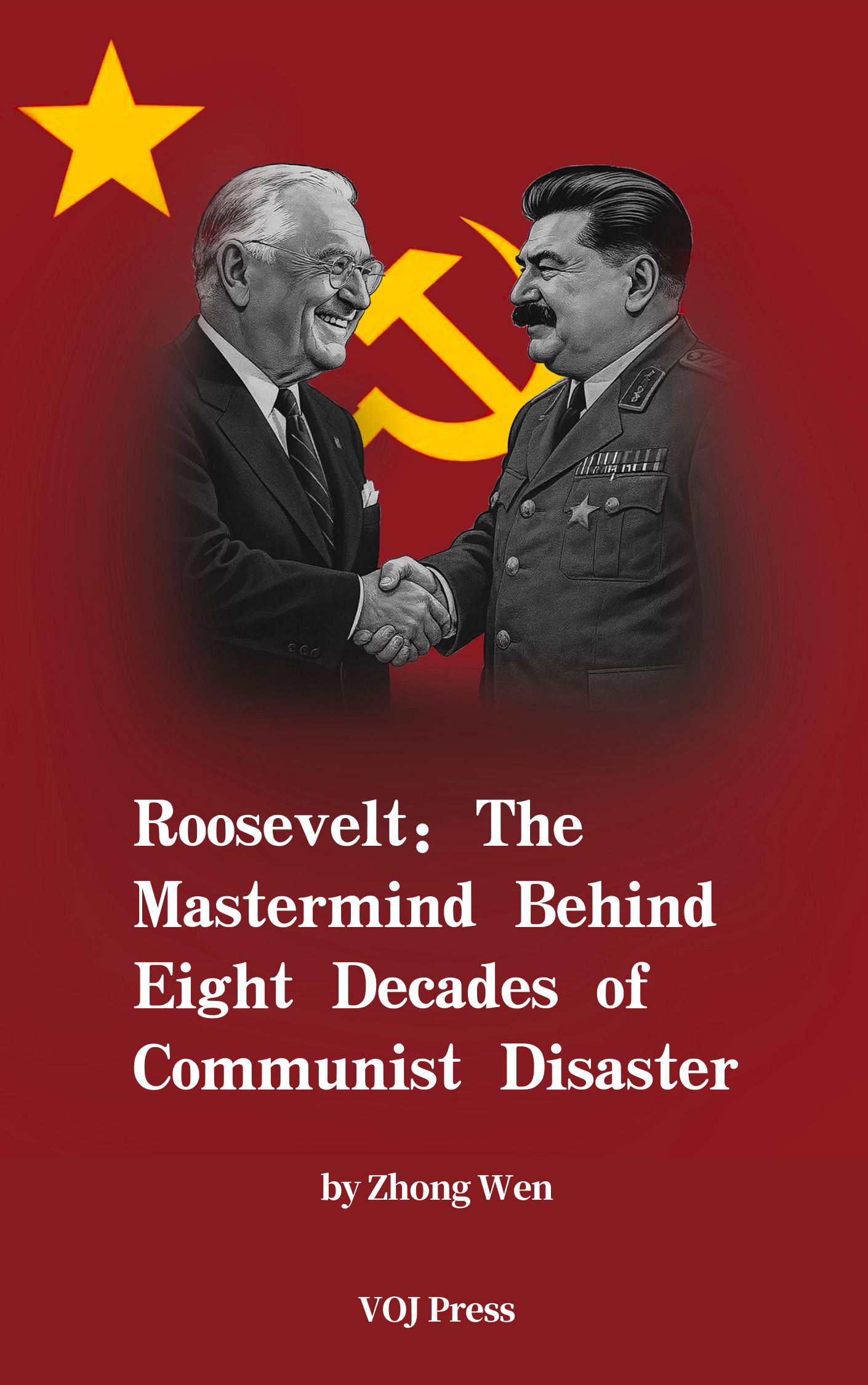
Roosevelt: The Mastermind Behind Eight Decades of Communist Disaster
Chapter 05
Roosevelt’s Alliance with the Soviet Union
III. Soviet Exports of “Bread Soaked in Blood”
During this period, the Soviet Union adopted the following foreign economic strategy:
First, exchanging “bread soaked in blood” for imported technology.
By 1929, the USSR had signed over 70 technical assistance agreements with Western experts, covering key sectors such as metallurgy, industrial machinery, metal processing, energy, petrochemicals, transportation, agricultural machinery, irrigation engineering, automobile, shipbuilding, and aircraft manufacturing.
By 1931, the number of technical cooperation projects had grown to 124, with a total value of 83 million rubles (at the time, 1 ruble was worth approximately 0.5 U.S. dollars). Many of the core enterprises established during the First Five-Year Plan — especially in steel, heavy machinery, energy, chemicals, automotive, tractors, aviation, and shipbuilding — were built using imported Western equipment and technology, often with the direct involvement of foreign specialists.
According to American author Antony C. Sutton in his book Western Technology and Soviet Economic Development: 1930–1945, Stalin once remarked: “Roughly two-thirds of the large industrial enterprises in the Soviet Union were built with the help or technical assistance of the United States… The remaining ones were built mostly with the aid of Germany, Britain, France, and Italy.”
Second, using “bread soaked in blood” to massively import machinery.
During this period, the Soviet Union became the world’s largest purchaser of machinery on the international market. By 1931, 50% of all machinery exported by the United States was sold to the Soviet Union. From 1929 to 1930, 70% of the United Kingdom’s total machinery exports went to the USSR, and by 1932, that figure rose to 90%. In 1931, 30% of the world’s total machinery exports were destined for the Soviet Union; by 1932, that share had grown to 50%. In terms of Soviet import structure, machinery and equipment made up 30.1% of total imports in 1929, and that number surged to 55.7% by 1932. From 1929 to 1932, the Soviet Union spent a total of 6.01 billion rubles on machinery imports.
Third, using “bread soaked in blood” to prioritize the import of intellectual capital.
During the global economic crisis, many Western nations experienced widespread unemployment among skilled professionals. The Soviet Union seized this opportunity by recruiting a large number of these unemployed experts. By 1932, 1,919 foreign specialists and 10,655 foreign technicians were working in the Soviet Union — more than four times and over twenty times the respective figures from 1928. At the same time, the USSR actively sent its own personnel abroad through mechanisms like technical assistance agreements, seeking to absorb Western expertise firsthand. Between 1929 and 1933, the Supreme Council of the National Economy alone dispatched over 2,000 Soviet administrators and engineers to study overseas.
Fourth, using “bread soaked in blood” to attract foreign loans.
Before 1929, major Western powers were generally unwilling to lend money to the Soviet Union; and when loans were offered, they often came with harsh conditions. However, the global economic crisis created a surplus of idle capital in the West, which shifted the balance of power in the Soviet Union’s favor on the international financial stage. Between 1929 and 1931, the USSR secured loans from private banks in Germany, Austria, the United Kingdom, Italy, the United States, Finland, Japan, Norway, Sweden, Denmark, Belgium, France, and several other countries.
By the end of 1933, the total value of loans obtained by the Soviet Union had reached 1.4 billion rubles.
Fifth, proposing a cooperative arrangement of mutual exploitation in international economic relations.
At the World Economic Conference held in London in June 1933, the Soviet Union put forward a plan to expand foreign trade and enhance international economic cooperation. It proposed that Western countries provide long-term loans to the USSR in order to ensure the continuity of Soviet exports.
In return, the Soviet Union promised to place foreign orders totaling approximately $1 billion in the short term. Specifically, it signaled intent to purchase: $100 million worth of non-ferrous metals, $200 million in ferrous metals, around $100 million in textiles, leather materials, and rubber, about $400 million in industrial equipment, and $50 million in consumer goods.
These proposals were framed as mutually beneficial: they would fuel Soviet economic development while also helping Western nations alleviate the pressures of their own economic crisis.
On the surface, this painted the Soviet Union as a responsible global actor committed to international cooperation — despite the grim realities behind its internal economic practices.
The man-made Ukrainian famine and cannibalistic collusion with international capital — During the Great Depression, the Soviet Union’s economic policies embodied the cannibalistic spirit of communism: tightening control over foreign exchange and tariffs, and constructing a “firewall” to ensure economic security.
During the NEP period, the Soviet Union briefly allowed limited private foreign exchange activity. But by 1930, it moved to impose total state control over foreign trade, currency exchange, and tariffs — abolishing all foreign exchange and securities markets.
While this temporary measure helped block the spread of the global financial crisis into Soviet territory, it was never rolled back, even after the Depression ended or after World War II. Instead, it was perversely celebrated as a core feature of the socialist economy.
What began as “protective” economic regulation turned into a rigid barrier to development. In truth, a so-called “people’s regime” that governs against the people is no more than a parasite. Communism revealed its true nature as a vampiric system — sucking blood at home, and exploiting chaos abroad.
 正义钟声 Voice of Justice