
Roosevelt: The Mastermind Behind Eight Decades of Communist Disaster
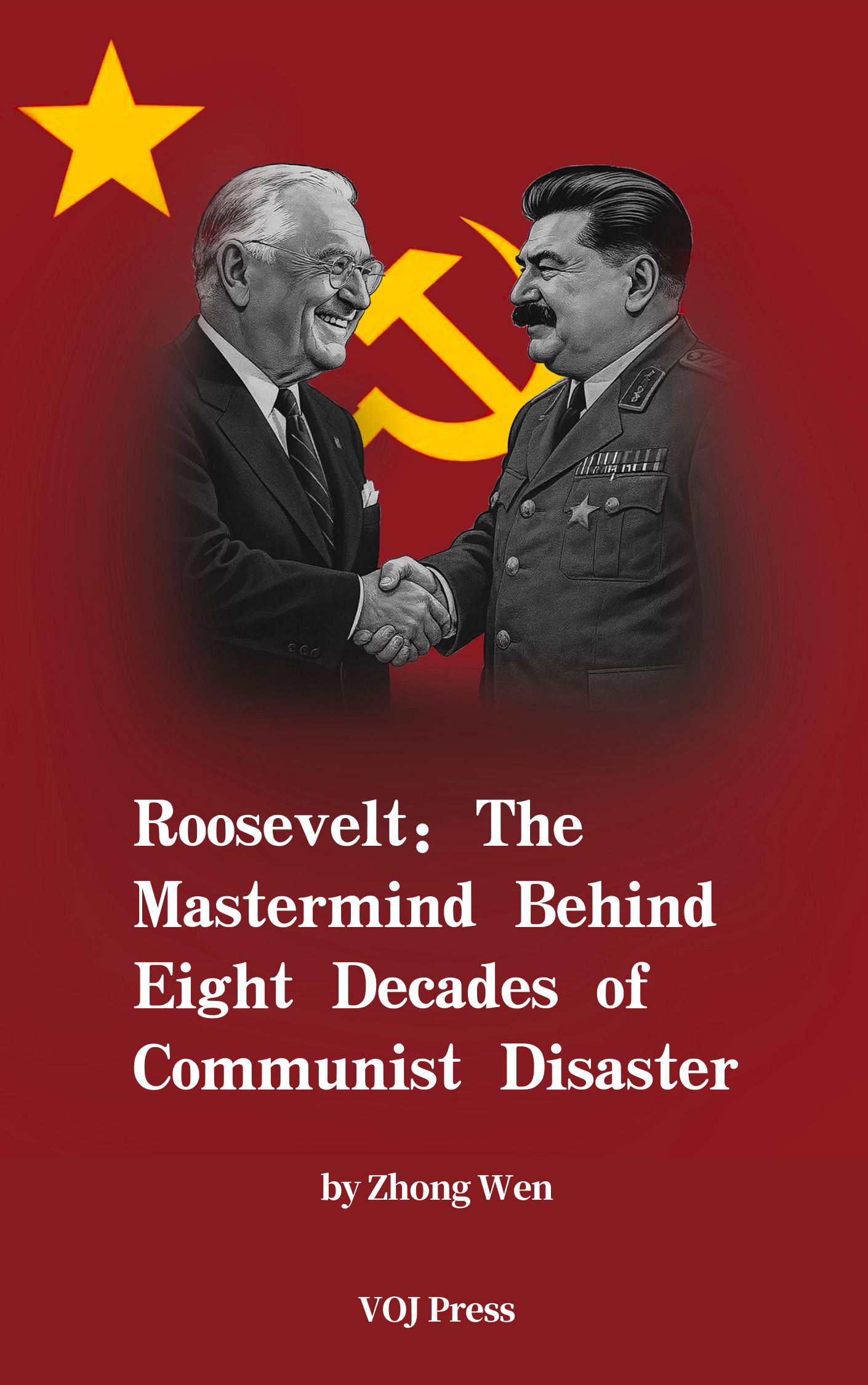
Chapter 03
Roosevelt’s Election: A Blessing in Disguise
Hoover’s caution resembled old-fashioned laissez-faire liberalism. As the great pioneer of American corporatist nationalism, it is ironically fitting that such an image would be the final impression of his career. However, this gave Roosevelt an opportunity to seize the credit and exploit the situation for his own gain. Thus, the propaganda of the “New Deal” under Roosevelt obscured the earlier efforts of Hoover’s own “New Deal.” In this way, lies were used to cover up history. As the saying goes — Roosevelt turned disaster into political fortune in the election, and from then on, America stepped onto a path of no return.
I. The Beginning of Roosevelt’s New Deal
In the 1932 U.S. presidential election, taking advantage of the catastrophic 1929 Wall Street stock market crash, Roosevelt seized the moment to attack Hoover and ultimately won. In reality, Hoover had been steady and methodical, with sound governance and rich experience. After three years of leadership, his policies were already beginning to show significant results.
On the night of his inauguration, Roosevelt deliberately orchestrated a dramatic moment: all the lights suddenly turned on, followed by a staged outburst of cheers from the public. Thus began the “New Deal” …… But in truth, Roosevelt merely picked up where Hoover had left off, continuing the very policies Hoover had already set in motion — nothing more than a gilded continuation.
Murray N. Rothbard (1926–1995), author of The Progressive Era, believed that it was actually “Hoover’s New Deal” that combated the Great Depression. Hoover was the mobilizer and economic planner during World War I; he consistently advocated for industrial stabilization through business cartels and government-business cooperation. He was the first to promote pro-labor union policies in industry to ensure labor cooperation; he supported high wage standards to maintain purchasing power and commercial prosperity; he actively backed large-scale public works projects during the economic downturn; and he encouraged raising agricultural prices and promoting agricultural cooperatives through government programs. No one, Rothbard argued, was better suited than Herbert Clark Hoover to serve as president at the onset of the Great Depression and to respond to the crisis by initiating a radical, centrally planned program later known as the “New Deal” — which, in fact, was Hoover’s doing.
However, the greatest irony of history is that Herbert Hoover — the very architect behind every policy measure of Franklin D. Roosevelt’s New Deal — was instead portrayed as ‘the last staunch defender of laissez-faire capitalism.”
When the stock market crashed on October 24, 1929, Hoover immediately launched his “super-sized” intervention plan. One of his most significant actions was to convene a series of White House Conferences with leading financiers and industrialists in the United States, urging them not to cut wages and to expand investments. Hoover explained that the overall goal of these meetings was to coordinate unified action between businesses and government agencies.
One industry group after another pledged to maintain wage levels. Hoover firmly believed that the current economic downturn was fundamentally different from previous depressions, where wages had dropped rapidly and sharply (we might note that those earlier depressions often ended quickly). Now, in order to sustain mass purchasing power, wages had to be the last thing to fall. As a result, the full burden of the economic contraction was placed squarely on business profits. The most significant of these meetings occurred on November 21, when major industrial leaders such as Henry Ford, Julius Rosenwald, Walter Teagle, Owen D. Young, Alfred P. Sloan Jr., and Pierre du Pont pledged their support for Hoover’s plan. These agreements were made public, and at the December 5 White House Conference, Hoover praised them as “a conceptual advancement in the relationship between business and public welfare …… a far cry from the arbitrary and antagonistic attitude of industry thirty or forty years ago.” The American Federation of Labor welcomed this development, declaring that industrial leaders had “never before been asked to act in concert.” By March of the following year, the AFL reported that major corporations were indeed honoring their commitments and maintaining wage standards.
Throughout the Great Depression, Herbert Hoover displayed a clear aversion to speculation and the stock market. In the fall of 1930, Hoover threatened to impose federal regulation on the New York Stock Exchange, which until then had been considered subject only to state oversight. Hoover pressured the Exchange into “voluntarily” agreeing not to issue loans for short selling. In 1932, Hoover renewed his offensive, declaring that the federal government would take action against short selling. He also strongly encouraged the Senate to investigate what he called “malicious …… bear raids” on the market. Hoover appeared to believe that valuing stocks based on current (and depressed) earnings amounted to a kind of moral betrayal. He then proposed the creation of a regulatory body — a proposal that would later materialize as the Securities and Exchange Commission (SEC) under the New Deal. Hoover publicly expressed approval of this regulatory agency.
When the Great Depression struck, Hoover’s Federal Farm Board was already poised to act — implementing a prototype of the New Deal’s agricultural policy, with the aim of raising and stabilizing farm commodity prices.
The first major initiative of the Federal Farm Board targeted wheat. The Board advised willing wheat farmers to act like a cartel — in short, to suspend wheat sales and wait for prices to rise. It then issued $100 million in loans to wheat cooperatives to hold wheat in storage, thereby supporting prices. The Board also established a central grain corporation to coordinate the efforts of the wheat cooperatives.
When the loans to cooperatives failed to stop the decline in wheat prices, the central grain corporation began purchasing wheat directly. The loans and purchases initially succeeded in stabilizing wheat prices for a time, but by the spring of 1930, the program had encouraged farmers to increase production, which only worsened the wheat surplus and led to further price declines.
The Hoover administration clearly recognized that cartelization and price-raising policies would not succeed unless wheat production decreased. Under the leadership of the Secretary of Agriculture and the Federal Farm Board, a typical Hoover-style moral suasion campaign was launched. Washington sent a group of economists to the Northwest to persuade small-scale wheat farmers — original proponents of supporting wheat prices — to switch from wheat to other crops. Secretary of Agriculture Arthur M. Hyde and Federal Farm Board chairman Alexander Legge toured the Midwest urging farmers to reduce their wheat acreage. But, as expected, moral suasion proved ineffective. Wheat continued to pile up, and prices kept falling. By November, the government’s Grain Stabilization Corporation had purchased over 65 million bushels of wheat in an attempt to stop the price decline — without success. Then, in November 1930, Hoover authorized the Grain Stabilization Corporation to buy as much wheat as necessary to halt the falling prices. But economic forces were not so easily overcome — wheat prices continued to drop. In the end, the Federal Farm Board admitted defeat and began to sell off its stockpiled wheat, which only further depressed wheat prices.
Similar price support programs were also implemented in the cotton industry, but they resulted in equally disastrous consequences. James C. Stone, chairman of the Federal Farm Board, even mobilized state governors to plow under one row out of every three rows of cotton — yet it still had no effect. Similar cartelization efforts in the wool, butter, grape, and tobacco industries also led to catastrophic outcomes.
It became increasingly clear that without mandatory production limits, cartelization plans could not succeed; there were simply too many farmers, and voluntary moral persuasion was ineffective. President Hoover began moving in this direction, suggesting that fertile land be left untilled, crops be plowed under, and immature livestock be slaughtered — all to address the surplus caused by Hoover’s price support programs.
 正义钟声 Voice of Justice