
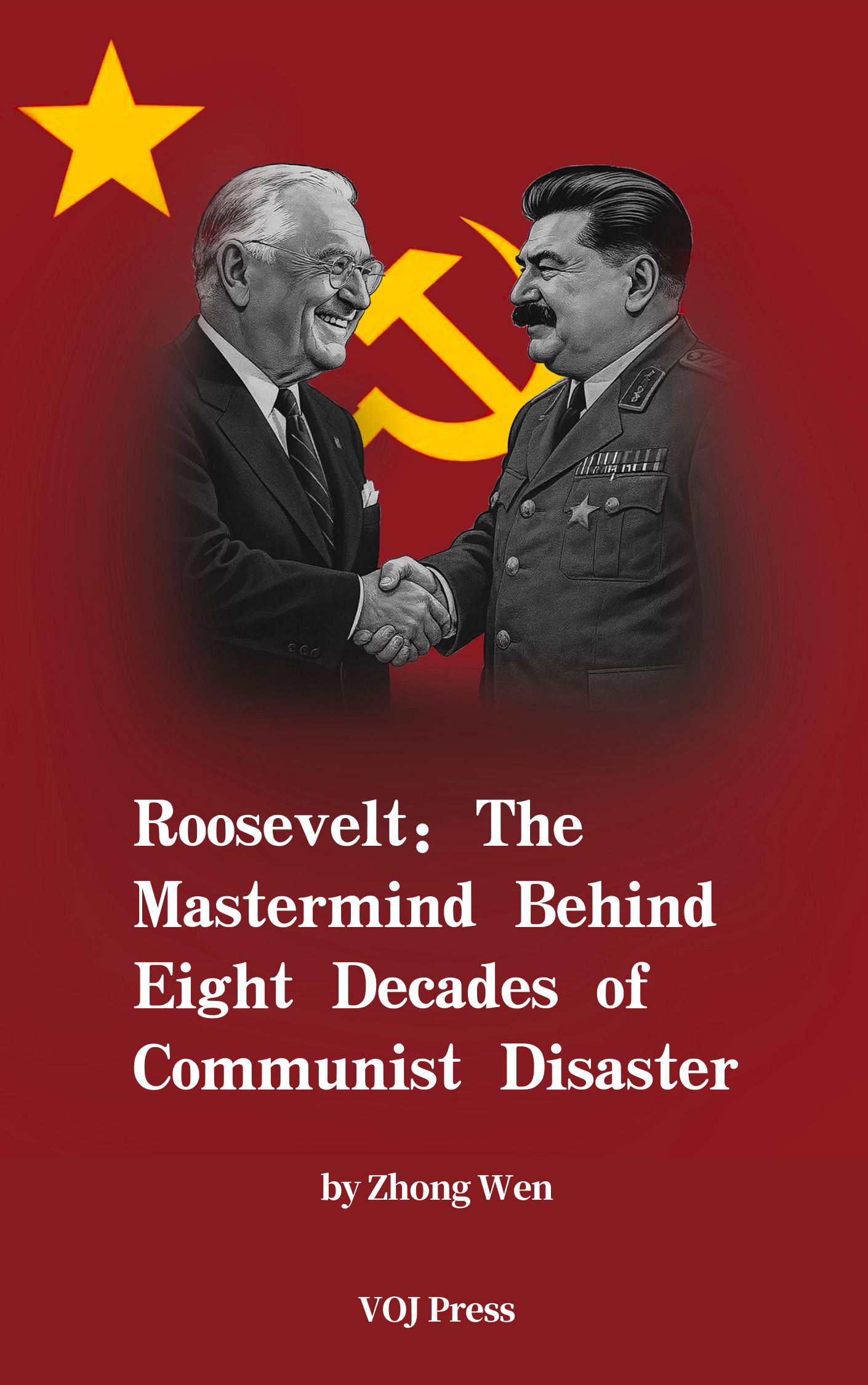
Roosevelt: The Mastermind Behind Eight Decades of Communist Disaster
Chapter 01
The Final Judgment on Roosevelt After 80 Years
The two Roosevelt presidents, though from the same prominent family, represented opposing political parties and each held the presidency in turn — a vivid embodiment of the essence of America’s two-party system. Now, nearly 80 years after the death of Franklin D. Roosevelt, sufficient time has passed for his legacy to be fully assessed and historically settled.
I. “American Heroes National Park” Excludes Roosevelt
On July 7, 2020, the Chinese Communist Party’s mouthpiece, Global Times, reported on the tentative list of the “American Heroes National Park,” questioning why Franklin D. Roosevelt was absent from it. The full text is as follows:
In response to the recent wave of statue removals, U.S. President Donald Trump announced the creation of a “National Garden of American Heroes” during the Independence Day celebrations. According to a report by AFP on the 6th, Trump’s sudden announcement — made without thorough consultation — seems unlikely to ease the deeply divided partisan tensions in the country. Instead, it may raise further questions among Americans: What exactly will such a park look like? And when it opens on July 4, 2026, which heroes will it commemorate?
According to a BBC report on July 5, the executive order issued by the White House stated that President Trump insisted the new statues must be lifelike “and not abstract or modernist.” However, Trump’s selection of historical figures to be commemorated in the park sparked controversy. The executive order included a provisional list of 30 “heroes,” featuring figures such as Founding Father George Washington, World War II General Douglas MacArthur, and African American civil rights leader Martin Luther King Jr. The list also included non-Americans who made what was described as “substantial historical contributions to the discovery, development, or independence of the future United States.” As a result, it named Christopher Columbus — who is far from a hero in the eyes of Native Americans — while failing to include any Native American or Latino American figures.
In the view of Princeton University political historian Julian Zelizer, Trump’s idea of an American Heroes National Garden is purely a political strategy. He believes that some of the figures on the preliminary list are aimed directly at the political right — such as the late conservative Supreme Court Justice Antonin Scalia — while omitting any modern left-leaning historical figures like Franklin D. Roosevelt.
James Grossman, executive director of the American Historical Association, told The Washington Post on the 5th, ‘the selections are all over the place — some are odd, some may be inappropriate, and some seem deliberately provocative.” Grossman explained that Trump’s executive order called for the creation of a special task force and a report within 60 days detailing plans such as the park’s location. ‘this appears to be a blatant attempt to seize on cultural conflict as a distraction,” he said.
According to Grossman, the urgency behind building the park stems from the upcoming election, but such a move undermines the true purpose of erecting statues. He said, “First, you could consult with different communities to understand who they see as heroes, rather than choosing them yourself. You might also want to consult with professionals — like actual historians.”
David Cox, a history professor at the University of North Carolina at Charlotte, believes that perhaps even worse than the arbitrariness in choosing heroes is the clear political motivation behind the park. “It doesn’t address real problems; it doesn’t address the genuine debates and turmoil going on in this country,” he said.
According to an analysis by the BBC, Trump, in his July 3rd speech at Mount Rushmore, harshly criticized protesters he claimed were destroying the nation’s cultural heritage. The proposed Heroes Park is seen as a symbolic response — a grand tribute to American exceptionalism, signaling that the upcoming fall presidential campaign will likely be a fierce cultural war.
Zhong Wen remarked: One might reasonably ask why the Chinese Communist Party appears particularly perturbed by the omission of Franklin D. Roosevelt from the preliminary list for the proposed “National Garden of American Heroes.” In my view, this stems from the Party’s longstanding admiration for Roosevelt. But why such admiration? It is likely because the Chinese Communist Party has historically regarded Roosevelt as a political figure whose ideals were broadly aligned with, or at least sympathetic to, the goals of international socialism.
 正义钟声 Voice of Justice