
The Concord of the Five Religions
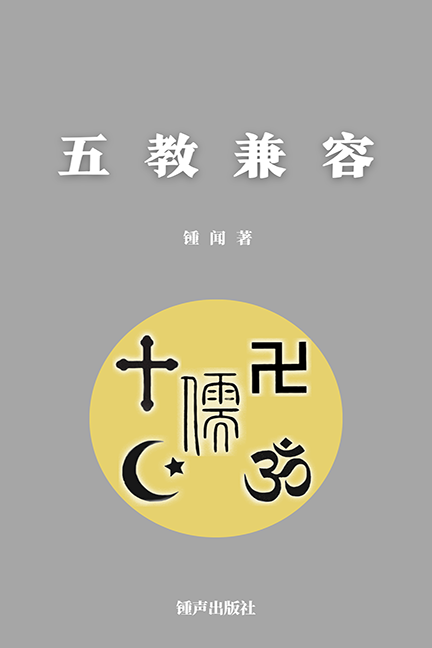
Preface by Zhong Wen
Five Religions in Harmony is an objective, fair, and concise introduction to the history and doctrines of the “five religions”: Christianity, Islam, Buddhism, Hinduism, and Confucianism. It is a rare and excellent work. World peace requires the foundation of “compatibility among the five religions.” The world today is chaotic precisely because the “five religions are incompatible,” especially the incompatibility between the two largest—Christianity and Islam. Throughout history to the present, each claims its God is the only true one, rejecting the other, making the world far from peaceful.
Since Martin Luther split from Rome and created Protestantism more than 400 years ago, the Christian world suffered centuries of war. Even different Christian denominations are mutually incompatible. Both World War I and World War II were initiated within Christian countries; nearly all participating European nations were Christian. After Luther’s break, the Pope lost authority, and Christianity became subordinate to secular states—“the state first, the church second.” Without the Church’s restraining power, no one could prevent wars. During World War II, even Roosevelt allied with Stalin against the anti-communist Hitler, resulting in the rise of the catastrophic communist century, which still has not ended.
Four hundred years ago, however, Jesuit Matteo Ricci chose a different path in the East. He discovered Confucius and translated the Analects, introducing Confucianism to the West. Ricci achieved a harmony between Jesus and Confucius, establishing what came to be known as the “Ricci Rules,” which permitted Christians to honor Heaven, venerate ancestors, and perform Confucian rites. These “Ricci Rules” were initially recognized by the Pope. But not long after Ricci’s death, another faction brought accusations to Rome, and the Vatican reversed its approval. It was not until 1939 that the Pope reinstated the “Ricci Rules,” acknowledging the compatibility of Christianity and Confucianism—a position held to this day.
Luther’s break caused a 400-year decline of Christian civilization. Luther attacked the Roman Church as “a brothel of the most shameless sort, a kingdom of sin, death, and hell.” This can still be seen in world civilization textbooks. After reading such things, how can young people today still believe in the Church or attend services? No wonder church attendance in Western Europe has dropped to 10%. Many churches have been repurposed or even converted into mosques. Islam, having never undergone a “Luther-style Reformation,” has never been widely questioned; God is unquestioned, and its unity of religion and state gives it sweeping momentum. With no internal rebellion, it now threatens to surpass Christianity. Christianity, in its birthplace of Europe, is in decline and survives mainly in Latin America and Africa.
For the past 400 years, the world’s major battleground has been Europe; the East has been comparatively peaceful, and even today the turmoil remains centered in Europe and the Middle East. In the future, harmony among the five religions is essential. Above all, the two giants—Christianity and Islam—must reconcile. Christian denominations must reconcile with one another, and Eastern Orthodoxy must reconcile with Western Christianity.
At the founding of each religion, they existed in separate, isolated regions with little contact. Each emphasized “I am the only true God” to strengthen believers’ faith—a claim understandable in its original context. But today, in an age of globalization where the world has become a “global village,” to insist again that “I am the only true God” is no longer objective. In reality, each religion has its own god(s), all of whom are “true.” If these “true gods” continue to oppose one another, it will only repel people.
The Krishna tradition of Hinduism embraces a pluralistic religious worldview: they worship Krishna as the supreme deity while acknowledging that the gods of Christianity, Judaism, Islam, and others are manifestations of Krishna. This reflects the inclusiveness of a polytheistic system—one that does not reject other religions and maintains respect for them. This attitude is commendable and worth promoting.
Among the five religions, Confucianism, Buddhism, and Hinduism are comparatively peaceful. Historically, they have never initiated major wars. These three traditions can help mediate reconciliation between the two largest religions.
However, Confucianism is still suppressed under the Chinese Communist Party and has not yet revived. Only after Xi Jinping falls and Confucianism is restored can it help bring the “big two” together, fostering compatibility and promoting world peace.
Zhong Wen
April 11, 2025
 正义钟声 Voice of Justice