
A Concise Reinterpretation of Modern Chinese History
Preface 5: Revisiting is a History of Modern China
Zhang Jie
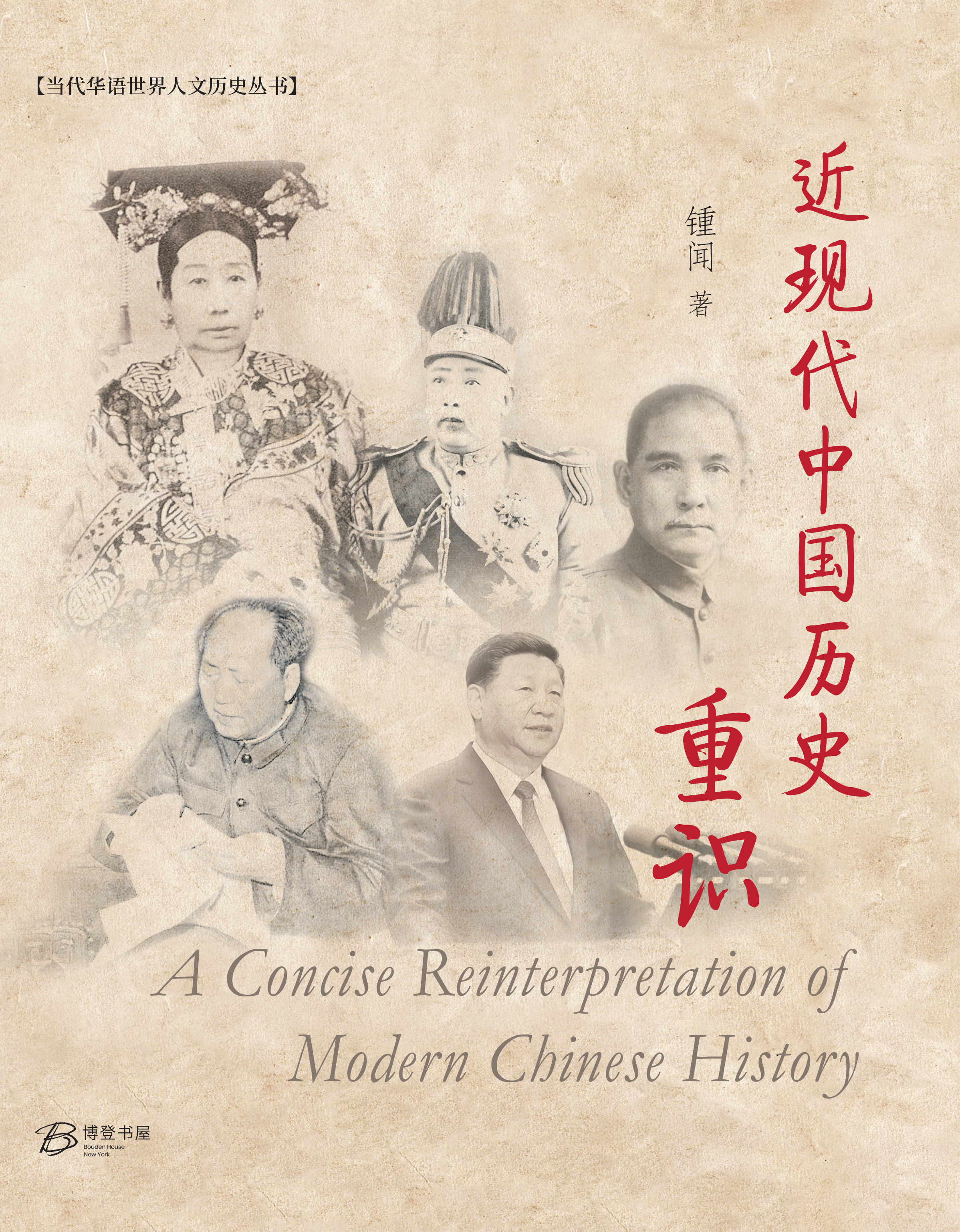
Mr. Zhong Wen’s new work, *Revisiting*, is a history of modern China, spanning from the height of the Qing Dynasty during the reign of Emperor Kangxi to the present day. It presents us with a magnificent yet bittersweet and turbulent history, leaving a lasting impression.
The title *Revisiting* indicates that Mr. Zhong Wen is not merely reminiscing about this history, but rather reinterpreting and analyzing this period of history that has influenced the Chinese nation and even the world through reflections on key political figures and historical events. Since it is a “revisiting,” it naturally contains viewpoints different from those of the historical community, even some subversive ones. In *Revisiting*, Mr. Zhong Wen highly praises Empress Dowager Cixi’s “reform and opening up” in the late Qing Dynasty; he thoroughly negates the Taiping Heavenly Kingdom and Hong Xiuquan; he affirms the historical contributions of important Qing officials such as Zuo Zongtang, Zeng Guofan, Li Hongzhang, and Zhang Zhidong; however, he believes that Kang Youwei, the leader of the Hundred Days’ Reform, “had merit in promoting reform in the first half of his life, but made mistakes in the second half.” Mr. Chung Wen believed that Liang Qichao was the foremost thinker of constitutional monarchy in China, while Hu Shi, the founder of the New Culture Movement, actually admired Confucius, not his mentor, the pragmatist master John Dewey. He offered unique evaluations of prominent figures in the Beiyang Government, including Yuan Shikai, Li Yuanhong, Zhang Xun, Feng Guozhang, Xu Shichang, Cao Kun, Feng Yuxiang, Duan Qirui, Wu Peifu, and Zhang Zuolin. When discussing the Kuomintang, Mr. Chung criticized Sun Yat-sen, praised Chen Jiongming, affirmed Wang Jingwei’s moral character, condemned Zhang Xueliang for his “reckless actions and naive thinking,” blaming the Xi’an Incident for a grave mistake, and praised Chiang Kai-shek for unifying China, his firm resistance against Japan, and his anti-communist stance, while also criticizing his historical error of losing the mainland. He highly praised Chiang Ching-kuo for initiating democratic politics. Regarding the Chinese Communist Party, Mr. Zhong Wen thoroughly criticized Mao Zedong’s crimes against the Chinese nation, gave Deng Xiaoping a “50/50” assessment of his merits and demerits, affirmed the outstanding historical contributions of Hu Yaobang and Zhao Ziyang to reform and opening up, and praised Chen Duxiu’s adherence to righteousness and Qu Qiubai’s unwavering integrity in pursuing truth. Mr. Zhong Wen summarized eight dark moments in Xi Jinping’s restoration of totalitarianism.
Whether Mr. Zhong Wen’s comments on numerous historical figures in *Revisiting History* are objective and fair remains to be judged by readers. I believe *Revisiting History* is not an academic work; its writing style is unique, and it can be considered Mr. Zhong Wen’s commentary notes on important political figures and events in modern China. However, this unconventional approach also has some shortcomings. First, the article’s structure is somewhat disjointed, and the commentary on historical figures and political events is not comprehensive enough. Second, the evaluations are highly subjective. Examples of shortcomings include: the Great Famine during the Mao era that killed 50 million people; Lin Biao’s death in a plane crash caused by a CCP missile strike; Deng Xiaoping’s Tiananmen Square crackdown that killed 32,000 students and citizens; Li Keqiang’s attempted assassination by Xi Jinping; and US President Biden’s two acquittals of Xi Jinping. Thirdly, some historical events are evaluated in a way that overlooks their complexity. For example, Emperor Daoguang’s commission of Lin Zexu to ban opium led to the Opium War between China and Britain. While *Revisiting* highly praises the Qing Dynasty’s ban on opium, it fails to point out the conflict between the Qing Dynasty’s closed-door policy and Britain’s free trade, the Qing Dynasty’s tributary system which prevented Britain from negotiating trade imbalances, the Qing officials’ inconsistent policies on the opium trade, and Lin Zexu’s forced ban on opium, which trampled on Britain’s diplomatic bottom line and trade relations. Fourthly, there is repetition in the commentary on political figures and events.
Despite these shortcomings, Mr. Chung Wen’s sense of historical responsibility and moral courage remain undiminished. Although *Revisiting* appears loosely structured, it embodies the author’s desire to refute the CCP’s fabrication of history and restore historical truth. Mr. Chung Wen, now a ninety-year-old sage, still reads, writes, and contemplates daily. This spirit of lifelong learning, lifelong reflection, and lifelong self-improvement is a precious spiritual legacy for future generations. In the twilight of life, most people become pessimistic and even suffer greatly from illness. But Mr. Chung Wen remains healthy, sharp-minded, and at the peak of his creative powers—a truly remarkable feat. His unwavering pursuit of truth and love of knowledge embody the principles advocated by Zixia in the *Analects*: “To learn extensively and be resolute in one’s will, to inquire earnestly and reflect closely—therein lies benevolence.”
Great indeed is Mr. Chung Wen!
This is the preface!
Zhang Jie (Independent Scholar, Doctor of Law)
January 20, 2024, Flushing, New York
 正义钟声 Voice of Justice