
A Concise Reinterpretation of Modern Chinese History
Preface 4: Preface to a Concise Reader on Re-understanding Modern and Contemporary Chinese History
Rong Wei
“All history is contemporary history,” a famous quote by the Italian historian Benedetto Croce. This should not be misinterpreted as “history is a little girl who can be dressed up however one pleases.” Here, history is understood not only as a concept of time but also as a concept of thought. We should understand that as people’s understanding of the world deepens and their knowledge expands, the discovery of historical truth, the understanding of causal relationships in historical events, and the historical evaluation of historical figures under specific historical conditions will become more profound and clear. In this sense, “all history is contemporary history” is a proposition of historical philosophy.
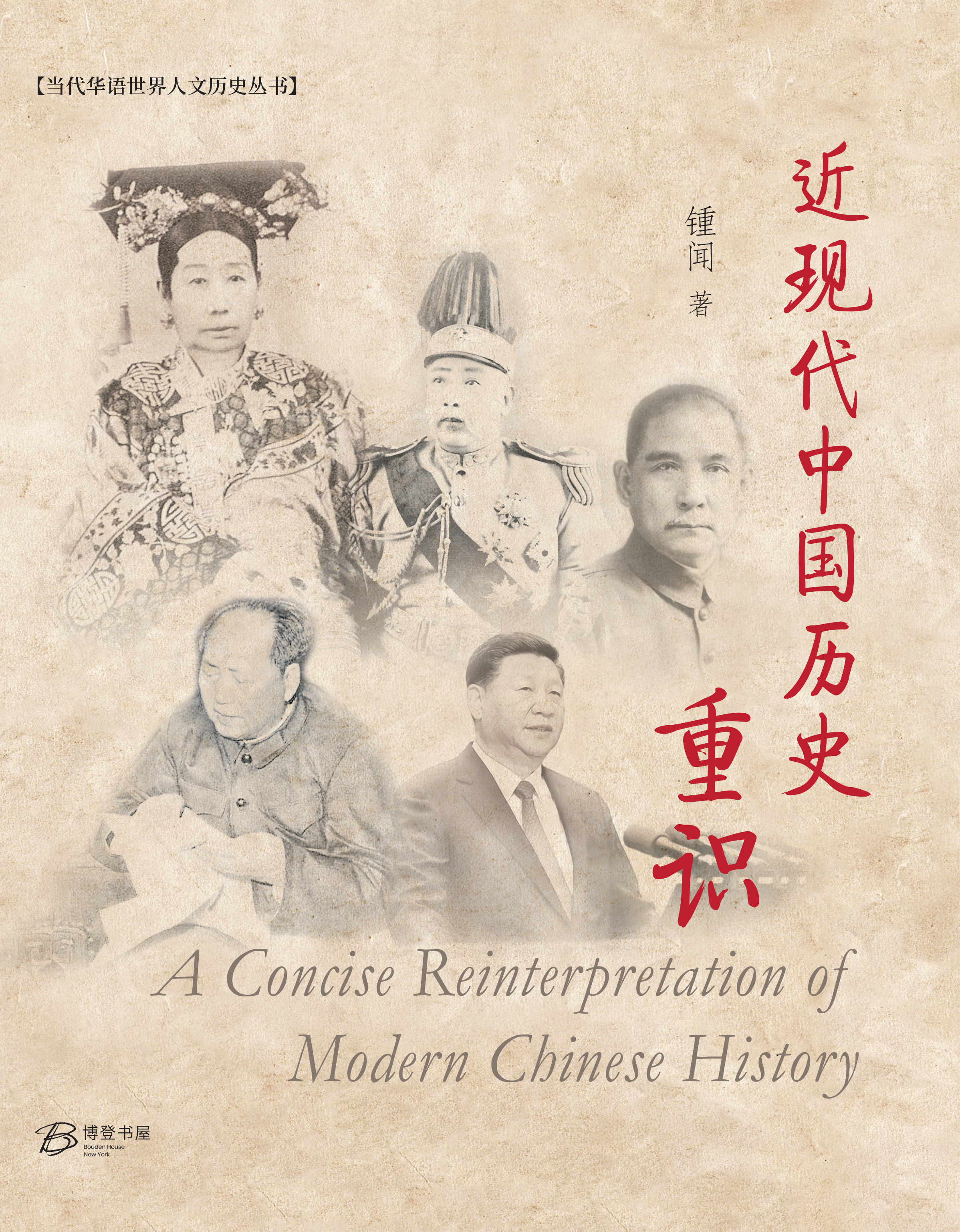
Mr. Zhong Wen, over ninety years old, continues to write prolifically. At our Boden Bookstore, we have already published *A Critical Biography of Xi Jinping* (Chinese and English versions), *A Century of Contest: Can America Defeat Communism?*, *Mao Zedong: My Confession*, and now this book, *Re-understanding Modern and Contemporary Chinese History*, which I call an indispensable history textbook for young people in the contemporary Chinese-speaking world.
We all know that after 1949, in order to distort history, the CCP completely obscured the truth in all primary and secondary school history textbooks. Generations like mine, supposedly raised under the red flag, suffered greatly from this; as a rock song by Cui Jian goes, we are all “eggs under the red flag.” Today, generation after generation of young people in China continue to receive a misled education. Growing up in an environment where thought is suppressed and freedom of speech is strictly controlled, their understanding of the world is inevitably severely flawed, and their knowledge of historical truth is completely obscured. This is what we often refer to online as “brain-dead” or “brain-deficient,” especially the so-called “little pinks,” who are severely brainwashed by this distorted history and truth-distorting education.
I know many young people who study abroad. Most of them initially showed obvious signs of being brainwashed by the Chinese mainland education system. However, after a period of study abroad and exposure to mainstream global values, they gradually understand the truth of the world and rediscover history. They begin to seriously reflect on their past education and ultimately completely abandon the “knowledge” instilled in them by textbooks fabricated by the CCP over the years to maintain its illegitimate rule. Miana, a student who studied in the US in her late 20s and early 30s, is a perfect example. Her review of Mr. Zhong Wen’s *A Re-understanding of Modern Chinese History* was brilliant! She wrote: “After reading *A Re-understanding*, I was quite shaken. For the past two years, I’ve been trying to understand ‘another side’ of history through various channels. This book allowed me, for the first time, to systematically, comprehensively, and objectively learn about the figures and stories of modern history. I even felt like I was ‘binge-watching a TV series,’ wanting more. I hope the author can publish a series of books, such as *A Re-understanding of Modern Historical Events*, connecting major events in modern history, such as the Opium War, the Hundred Days’ Reform, the Xinhai Revolution, the Northern Expedition, and the Xi’an Incident, weaving in the characters and creating a captivating narrative of modern history.” I’ve included her review at the end of the book for everyone’s reference. I believe this book will greatly inspire many young readers of Mr. Zhong Wen’s *A Re-understanding of Modern Chinese History*!
Mr. Zhong Wen’s book, *Re-understanding Modern Chinese History*, essentially re-examines and re-evaluates historical figures from the late Qing Dynasty to the People’s Republic of China. These figures are mostly household names, but their true historical identities and evaluations are not necessarily clear to everyone, and may even be misunderstood or obscured. Of course, there may be controversies, such as the historical evaluations of Empress Dowager Cixi and Sun Yat-sen. Our history textbooks have not provided comprehensive and accurate historical assessments of these figures, and some have even been distorted and one-sided, seriously misleading the next generation. I call Mr. Zhong Wen’s re-understanding a concise reader, which aligns with the reading habits of today’s young people. It allows for a quick and easy understanding of our turbulent and eventful modern Chinese history through the commentary on these historical figures and events. Of course, reviewing and commenting on modern and contemporary Chinese history is a massive historical undertaking. As Miana said, it involves re-examining and re-evaluating major historical events such as the Opium War, the Hundred Days’ Reform, the Xinhai Revolution, the Northern Expedition, and the Xi’an Incident. Perhaps Mr. Zhong Wen, at 90 years old, can no longer handle this task. It is hoped that our younger generation can take up this responsibility, unveiling the heavily veiled history and revealing the true face of modern and contemporary Chinese history—a history that has been “dressed up as one pleases.”
March 25, 2024, New York
NEXT: Preface 5: Revisiting is a History of Modern China
 正义钟声 Voice of Justice