
A Century-Long Contest
Preface II: If Communism Does Not Perish, Humanity Is Doomed
Yu Jinshan
Zhong Wen, who once served for many years as a journalist in the Chinese-language news media in the United States, withdrew from public life to a quieter rural setting yet continued to write tirelessly. He has successively published two books: Putting Mao Zedong on Trial and Four Hundred Years of America. The former takes Mao Zedong as its central thread to traverse modern Chinese history, portraying the many facets of life in “New” China; the latter offers a detailed account of four hundred years of American history, describing the nation’s continual refinement and evolution between founding ideals and lived realities.
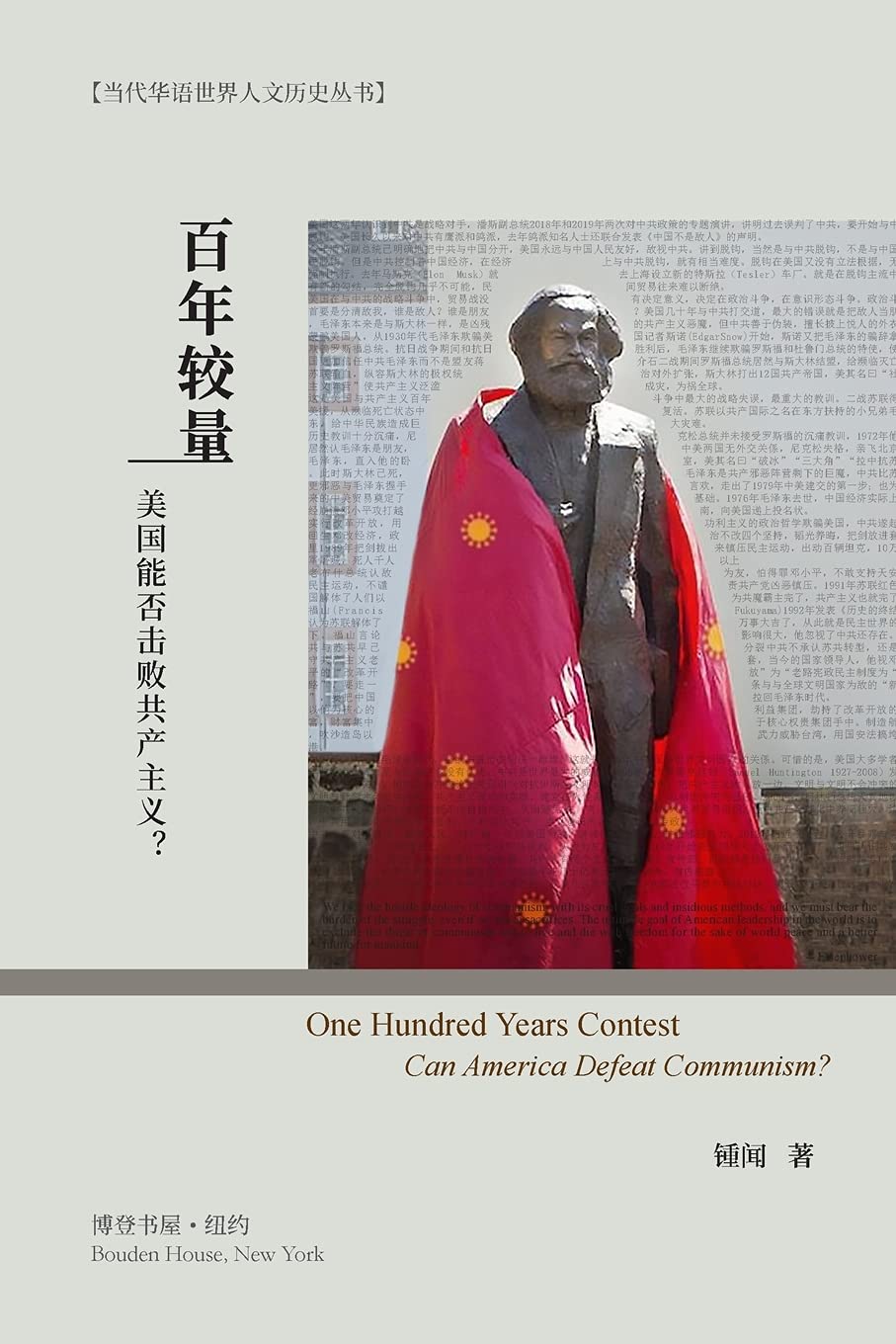
Zhong Wen’s latest work, A Hundred-Year Contest—Can America Defeat Communism?, records the history of America’s confrontations with communism since its rise, as well as America’s repeated misjudgments. The United States first encountered the communist countercurrent with the founding of the Soviet Union. President Woodrow Wilson, with keen insight, recognized the true nature of communism and joined forces with Belarus to resist the Soviet Communist Party, though the effort ultimately fell short. In 1921, the Chinese Communist Party was established, and communist power expanded further, entering China. Successive American presidents held ambiguous and unclear views of the CCP, allowing communist forces to grow steadily stronger.
In the book, Zhong Wen points out that in the 1930s the American journalist Edgar Snow wrote Red Star Over China, which romanticized Mao Zedong as a revolutionary fighting on behalf of impoverished peasants; the female journalist Anna Strong echoed Mao’s propaganda that “American imperialism is a paper tiger”; and Sidney Rittenberg painted a mirage of utopia during the Cultural Revolution. These aging Western leftists only awakened to reality late in life, but by then they had already caused Western countries to misjudge the Chinese Communist Party.
During China’s War of Resistance against Japan, the United States sent an observation group to Yan’an and mistakenly believed that the CCP was sincerely resisting Japan. After the war, American envoys sent to mediate the civil war between the Nationalists and the Communists—Patrick Hurley and later George Marshall, who went on to become Secretary of State—were likewise deceived. They believed that the CCP’s revolution was about liberating peasants and failed to see the Soviet Communist Party pulling the strings behind the scenes. Multiple ceasefire agreements were signed, none of which the CCP honored. Ultimately, the United States refused to aid Chiang Kai-shek, resulting in a tragic outcome that plunged the Chinese people into ninety years of suffering.
The sudden rise of communism, counted from Lenin’s seizure of power in the Bolshevik Revolution of 1917, has just exceeded a century. Although the Soviet Communist Party has vanished like clouds and mist, the Chinese Communist Party it left behind remains a powerful force in the world. That communism has endured for a hundred years without disappearing places an inescapable responsibility on the United States, which was founded on democracy and freedom in opposition to communism. Because of American misjudgments and errors, the communist tide continues to stir trouble today—errors that Zhong Wen enumerates one by one in this book.
Throughout its history of confronting international communism, the United States made repeated mistakes, allowing all of Eastern Europe to fall behind the Iron Curtain. During the war against Japan and the Chinese civil war, it likewise allowed the CCP to grow unchecked. The same errors were replayed in Vietnam and Cuba, where tens of millions of innocent people suffered catastrophe. Professor Liu Tongfang of the Marxism Institute at Zhejiang University has pointed out: “Every party that believes in Marxism, whether large like the Soviet Communist Party or small like the Khmer Rouge, has a history that is a history of bloody slaughter.” This observation cuts to the bone. Professor Liu further states: “After a century of practice, history and reality have already given a very clear answer to Marxism. Humanity has paid a terrible price for practicing Marxism.”
Why has communism brought such profound disasters upon humanity? From a historical perspective, Zhong Wen examines and presents in detail the century-long contest between the United States and communism, enabling readers to recognize the true nature of communism. Today, China and the United States have entered the nuclear age; the consequences of nuclear confrontation would be incomparable to the disasters inflicted by the Cold War or even by hot wars.
Zhao Shengye, a professor at Shenyang University of Technology and an adviser to Xi Jinping—hailed as a “state mentor” within the CCP—has proposed three methods for destroying the world: first, detonating a nuclear submarine loaded with nuclear warheads in the Pacific Ocean, creating waves exceeding 2,000 meters that would submerge all regions except the Qinghai–Tibet Plateau; second, simultaneously detonating several thousand nuclear warheads in the Himalayas to alter the Earth’s orbital path, sending the planet and all humanity drifting into the boundless darkness of space; and third, drilling 10,000 meters deep into the Sichuan Basin, burying several thousand nuclear warheads, and detonating them simultaneously to trigger a collapse of the Earth’s core, bringing about the end of the world and the extinction of humanity. The hatred for humankind revealed by Zhao Shengye and other Communist Party members is chilling beyond words.
If communism is not eradicated, humanity will face catastrophe. This is the truth that A Hundred-Year Contest seeks to convey.
Having spent most of his life in “New China,” Zhong Wen personally experienced the CCP’s dazzling propaganda and ever-changing tactics. He focuses on reviewing the tragic entanglements between the United States and the Chinese Communist Party. If likened to an unfortunate marriage, it would be one that came together through blindness and separated through understanding. Zhong Wen sees clearly why the United States once succumbed to blind faith in Beijing and why separation was inevitable. Having awakened himself, he hopes that the American people will also awaken—rising up as a whole, tearing down the Berlin Wall of information, forcing communism to exit the stage of history, and helping China transform into a constitutional democracy, becoming a nation of democracy and freedom.
 正义钟声 Voice of Justice