
A Century-Long Contest
Preface I: Who Is the Terminator of Communism
Li Yong
Mr. Zhong Wen is an outstanding journalist in the Chinese-language press in the United States. From the 1980s to the 1990s, he and I both worked in reporting within the New York Chinese community, so I paid close attention to his articles published in Chinese newspapers. Later, he left journalism to enter the real estate business and moved to Virginia. Even so, I continued to encounter his major works in newspapers and magazines. I noticed that he had broken free from the narrow confines of news reporting: his writing became broader in scope, more refined in style, sound in argument, and strikingly original in insight. Through the indirect introduction of Professor Xu Wenli of Brown University, we reestablished contact and have since corresponded frequently by email. My admiration for his unceasing dedication to writing has only deepened.
Earlier this year, Brother Zhong Wen informed me by email that he had a major work forthcoming. Eager for an advance look, I asked him to send me some sample chapters. Upon reading them, I gained an even greater appreciation of his talent: his arguments are incisive, richly documented, and presented with clarity and depth, inspiring genuine respect.
At the end of the Second World War, the world believed that peace was finally at hand. Few expected that Stalin’s Soviet Union, styling itself as the leader of the Communist International, would export revolution to Asian countries, producing a series of red satellite states. China was the first to fall victim, followed by Korea, Vietnam, and Cambodia. Wherever the red flag advanced, corpses littered the ground, rivers of blood flowed, and refugees fled in waves. Witnessing this upheaval, the United States stepped forward to contain the Chinese Communist Party and guard against the Soviet Communist Party, forming a barrier between democracy and freedom on the one hand and communist totalitarianism on the other—a barrier that endures to this day.
In Europe, the architect of catastrophe was Stalin of the Soviet Communist Party; in Asia, it was Mao Zedong of the Chinese Communist Party. These two monstrous tyrants were alike in their cruelty and brutality. Yet after Stalin’s death, Russia, under Khrushchev, subjected him to criticism, and forty years later the Soviet Union ultimately disintegrated. On the Chinese mainland, however, after Mao’s death, his successors have maintained one-party dictatorship to this day. These sharply divergent outcomes demonstrate that the Russian nation has engaged in a far more profound reflection on communism than has the Chinese nation.
Mr. Zhong Wen is widely read and deeply versed in American history. He points out that as early as 1919, U.S. President Woodrow Wilson openly expressed his antipathy toward the Russian Communists, judging that “the Bolsheviks came to power through violence and deceit, stand in opposition to the United States… and pose a greater threat to America than Germany.” This understanding laid the foundation for America’s anti-communist national policy, which has continued ever since.
There were, of course, reversals along the way. One notable example was November 1933, when President Franklin D. Roosevelt established diplomatic relations with the Soviet Union. Roosevelt appointed William Bullitt as the first U.S. ambassador. Bullitt discovered Stalin’s hostility toward the United States and even proposed severing diplomatic ties. Roosevelt, however, determined to maintain relations with the Soviet Union in order to counter German and Japanese expansion. When Germany invaded the Soviet Union in June 1941, Roosevelt even extended substantial aid to Moscow, drawing sharp criticism from former President Herbert Hoover.
From the Bolshevik seizure of power in 1917 to the communist takeover of mainland China in 1949, the United States gradually came to recognize the Communist International’s ambition for “world revolution.” Two opposing camps thus emerged: the “democratic nations” and the “Communist International.” The most conspicuous confrontation occurred when the United States, under the banner of the United Nations, sent troops to Korea and fought a bloody war against North Korean and Chinese communist forces—“seas of fire” against “human waves”—at enormous cost, thereby halting the Communist International’s ambition of turning the globe entirely red. Mr. Zhong Wen begins his narrative from this tide of crimson violence, awakening readers who may still be immersed in communist propaganda.
After finishing Mr. Zhong Wen’s major work, my first impression was this: it is a comprehensive and solid examination of the gains and losses arising from the fluctuations in America’s anti-communist policies over the past century—and, most importantly, it is fair and objective.
The book begins its account in 1919, the third year after the founding of the Soviet Union, when President Wilson condemned the Paris Commune and publicly declared his opposition to Russian communism. He stated plainly: “The poison of communism has already seeped into the veins of free peoples, and it negates America.” When President Herbert Hoover took office in 1929, he spoke even more bluntly: “The Russian Bolsheviks are a band of murderers; communism is an abyss.” In 1961, President Dwight D. Eisenhower declared during his administration that America’s ultimate goal was world peace and human welfare, and the elimination of the communist threat. In 1962, President John F. Kennedy proclaimed, “We must fight the spread of communism!” By 1983, President Ronald Reagan openly labeled the Soviet Union an “evil empire,” stating: “For many years it has deliberately murdered and abused its people. Millions have been slaughtered. Communism is a tragic and bizarre chapter in human history. That chapter is nearing its end. The Soviet communist regime will inevitably collapse.”
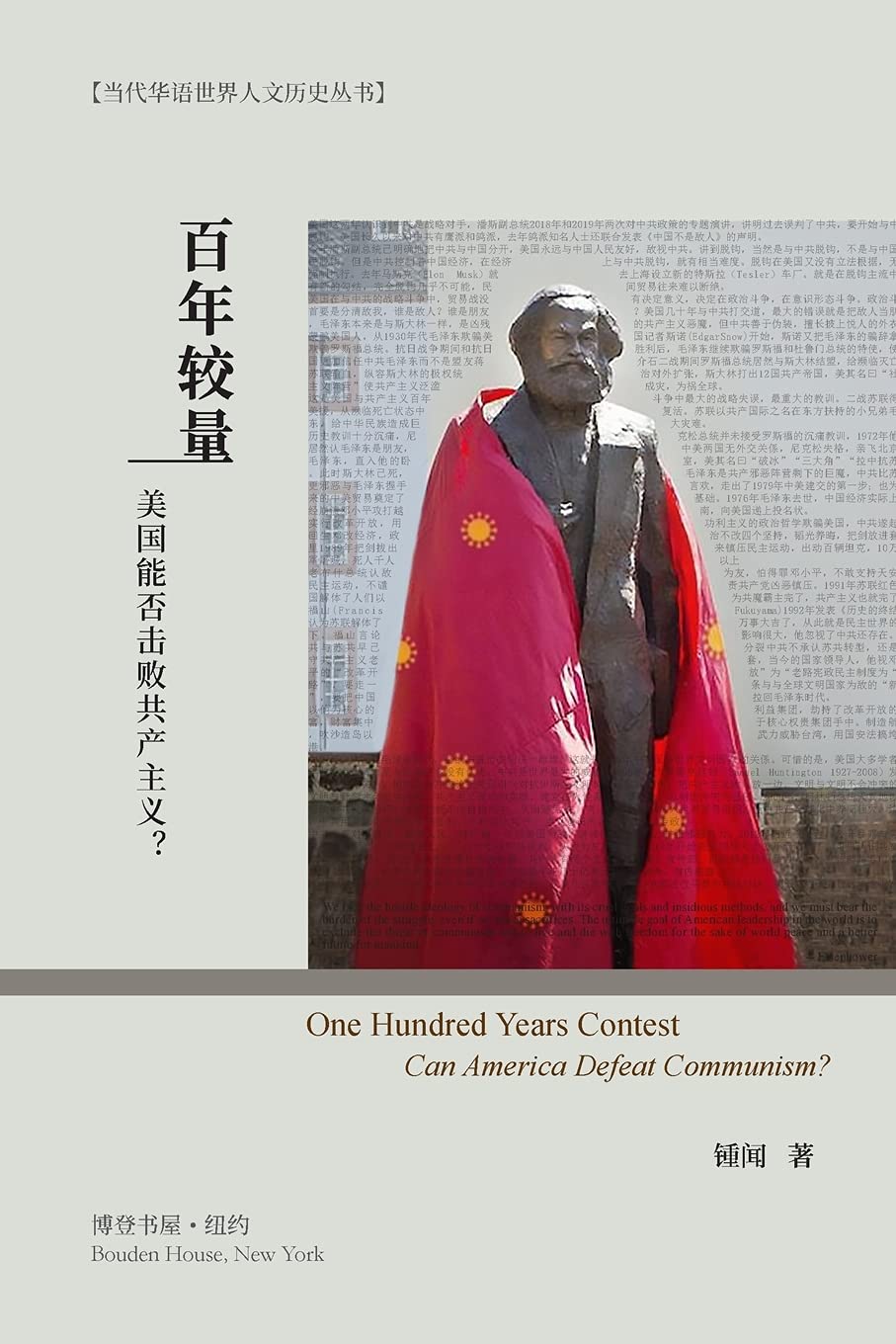
From the statements of these American presidents, it is clear that anti-communism is a political tradition of the United States and also its responsibility. As Mr. Zhong Wen writes, “America’s struggle with Marxist communism has been a long and arduous process.” This sentence refutes the communists’ habitual slander of the United States. They often claim that American anti-communism stems from hegemonic ambitions, denying America’s resolve to uphold global justice and peace and its goodwill in protecting those persecuted by communist regimes. This book records precisely that century-long struggle between the United States and communism.
In evaluating successive U.S. presidents, Mr. Zhong Wen assigns grades to their performance—fairly weighing successes and failures alike. He criticizes Roosevelt’s appeasement of Stalin, Nixon’s misjudgment of Mao Zedong, Carter’s overtures to Deng Xiaoping, and Clinton’s concessions to the Chinese Communist Party, all of which, in his view, created obstacles to world peace. Accordingly, his assessments of Roosevelt, Kennedy, Nixon, Reagan, George H. W. Bush, and Clinton are measured and well grounded.
Zhong Wen hails from the intellectual elite of mainland China. Having personally experienced and closely observed the Chinese Communist regime’s many perverse policies over the past seventy years, he possesses deep and intimate knowledge of its reality. For this reason, his denunciation of Stalin as a demonic figure and his critique of Mao Zedong as a tyrant are penetrating and incisive. His prose is righteous, forceful, and resounding—deeply impressive.
Thus is this preface written.
April 2021
 正义钟声 Voice of Justice