
A Century-Long Contest
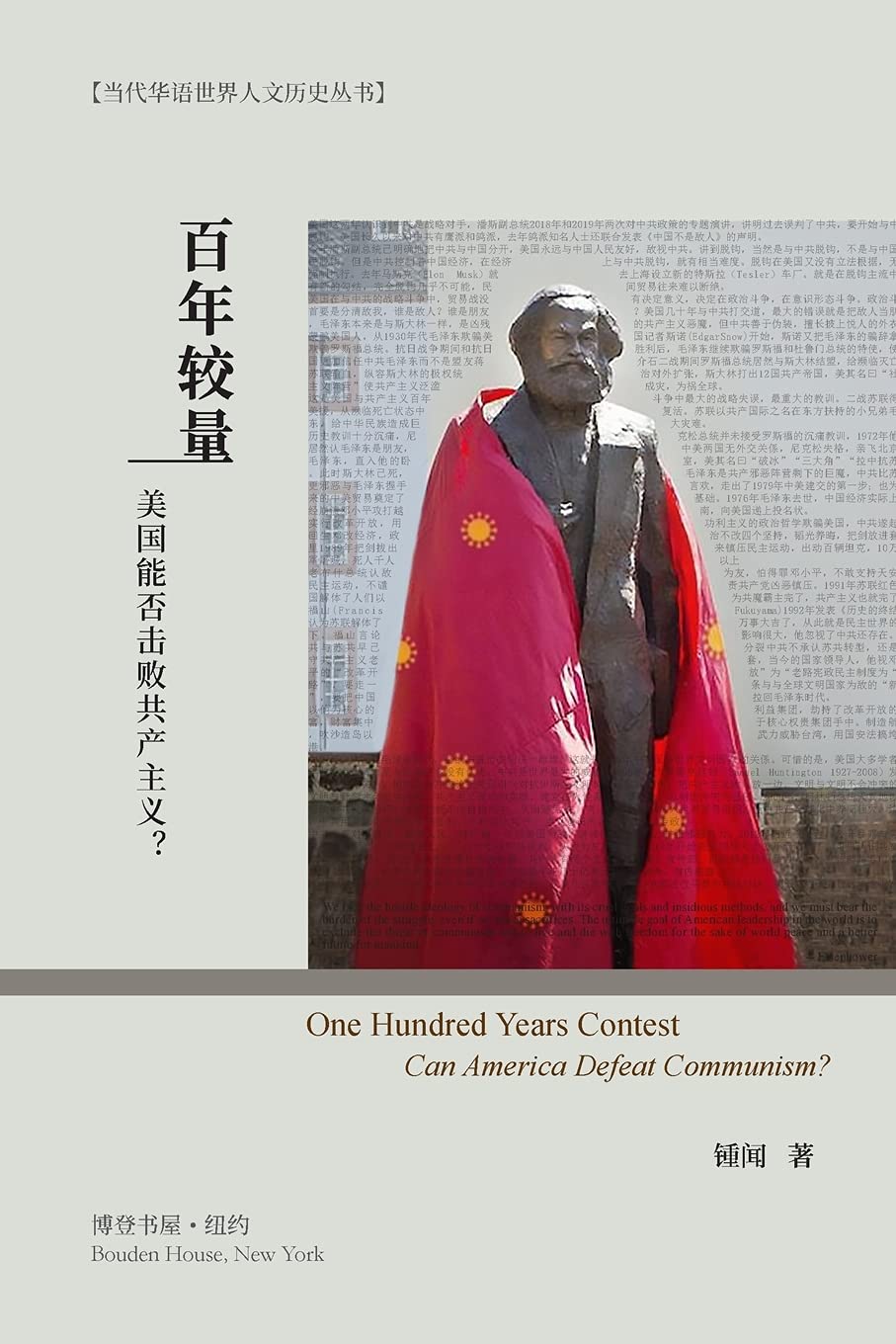
Chapter 33: America’s Anti-Communist Lessons (Part 8)
It is widely known that Karl Marx was a Satanist and that he followed Satanic doctrines until his death. The Communist Manifesto that he published begins with the famous opening line: “A specter is haunting Europe—the specter of communism.” The “specter of communism,” plainly speaking, is a demonic specter; Satan is the demon that openly opposes God. Satan seeks to overthrow the order established by God. Communism seeks to overthrow all existing orders.
Marx constructed his theory of subversion but died before he could put it into practice. Lenin picked up Marx’s subversive theory and, taking advantage of the chaos of World War I, incited violence in Russia, successfully seized power, overthrew Russia’s democratic government, and established a communist regime. Lenin created the Soviet system, implemented violent “proletarian dictatorship,” confiscated the property of the rich, eliminated wealthy peasants, suppressed all peasant resistance, and forcibly requisitioned grain from farmers, triggering massive famines that killed millions. This marked the first great communist catastrophe. Lenin’s theory overturned the order of God and inaugurated an era of human disaster whose destructive reach spread across the globe.
Under the banner of “proletarian revolution,” Lenin concealed crimes of plunder and murder. Lenin and his fellow communists were adept at using beautiful lies to cover up monstrous crimes. In 1919, while setting up concentration camps throughout Russia, Lenin simultaneously established the Communist International. Using wealth seized through robbery, he dispatched agents abroad to conduct illegal activities, bribing compromised Chinese intellectuals of the Republic of China—Chen Duxiu, Li Dazhao, and Lu Xun—to follow Comintern directives, distort truth and falsehood, and whitewash communist crimes. From that point on, “Red Terror” spread outward from Russia, leaving devastation and mass death wherever it went.
Stalin inherited Lenin’s violent revolutionary path and continued exporting subversive theory while funding the establishment of communist parties around the world. Individuals dissatisfied with their circumstances accepted Soviet financial support. Communist parties were formed in the United States, Britain, Germany, Italy, France, Spain, and elsewhere. Fortunately, these countries possessed belief in God; only a very small number of malcontents could be incited, and they never became a serious force.
In China, during the early years, only a small number of people were incited to join the Communist Party, and their activities remained largely theoretical rather than violent. Later, to meet Sun Yat-sen’s needs during the Northern Expedition, the Soviet Communist Party provided weapons, money, and advisors. After Sun Yat-sen’s death, Chiang Kai-shek successfully completed the Northern Expedition, overthrew the Beijing government of the Republic of China, and established the Nanjing National Government. In 1927, the Communist Party split from the Nationalists, set up its own camp, and launched violent opposition to Chiang Kai-shek’s government under the banner of Marxism. After twenty-two years of bloody civil war, Mao Zedong overthrew the Republic of China in 1949 and established a communist empire in Beijing—the CCP state.
Mao Zedong was even more brutal than Stalin. Why was Mao able to overthrow the Republic of China through violence? Fundamentally, because China lacked belief in God and thus had no defense against the demons of Satanism. Without strong religious faith to resist it, China was conquered by the communist virus and plunged into decades of catastrophe.
By contrast, consider China’s neighbor India. With a comparable population and closer geographic proximity to Moscow, Stalin also sought to export communism to India. China and India were his two major targets. Communist parties were likewise funded and established in India. Yet the Indian Communist Party failed to incite the masses to violently overthrow the government. The reason lay in India’s strong indigenous religious traditions and its emphasis on humanity and peace. The people supported Gandhi’s nonviolent resistance movement, and Britain had implanted a system of local parliamentary governance. Western parliamentary systems depend on belief in God, and in practice India also absorbed belief in God through this institutional inheritance. These combined national conditions enabled India to resist the invasion of the “communist virus.” The Indian Communist Party could not mobilize armed violence, sparing India from the communist catastrophe that killed tens of millions in China.
During the 1930s and 1940s, President Franklin D. Roosevelt set aside belief in God and chose to ally with Stalin, who stood in opposition to God. He first helped Stalin overturn Eastern Europe, and later, through Stalin, helped Mao Zedong overthrow the Republic of China. Roosevelt committed a grave error.
In 1972, President Richard Nixon repeated Roosevelt’s mistake. He abandoned the policy of containing the Chinese Communist Party that had existed since the Korean War and befriended Mao Zedong, who was even more vicious than Stalin. At the United Nations, Nixon abandoned America’s ally Chiang Kai-shek and again set aside belief in God. Chiang Kai-shek was a Christian who believed in God; Mao Zedong was a lawless Leninist. Mao inherited Leninism in its purest form and pushed subversion further than Stalin—politically, economically, in folk beliefs, and in traditional culture—overturning every Chinese institution. No one in ancient or modern times, East or West, surpassed him in this regard. By extending an olive branch to China, Nixon saved Mao, saved the Communist Party, and saved the remnants of communism, unleashing a flood of forces bent on undermining Western constitutional democracy.
Why is communism a calamity for humanity? British philosopher Bertrand Russell believed that the cost humanity must pay to achieve communism through Bolshevik methods was far too great—and that even after paying such a cost, it was impossible to believe the promised results could be achieved. Russell’s student Xu Zhimo, after visiting Soviet Russia, wrote in European Travel Notes:
“They believe that heaven exists and can be realized, but between the present world and heaven lies a sea—a sea of blood. Humanity must swim across this bloody sea to reach the other shore. They have decided to realize that sea first.”
Xu Zhimo also wrote: “According to your ideals, the price humanity must prepare to pay is something you yourselves may not have calculated clearly; the taste of the sea of blood—in other words—is something we have not yet tasted on a large scale.”
In the 1930s, Xu Zhimo debated in his Beijing Morning Post column whether the Soviet system was worth China’s imitation. This debate was influenced by discussions between Bertrand Russell and French writer André Gide. During the Great Depression, when democratic capitalist economies were struggling, the Soviet state-socialist economy appeared impressive. As a result, many Western leftists traveled to the Soviet Union as pilgrims. After their visits, they reached different conclusions. Gide believed the Soviet communist system represented the future hope of humanity. Russell, however, argued that although everyone in the Soviet Union had work, people had no freedom, and therefore the Soviet system had no future.
Chinese-American political commentator Li Yong pointed out that between 1971 and 1973, numerous prominent intellectuals traveled repeatedly to mainland China. After President Nixon’s visit to China and his meetings with Mao Zedong and Zhou Enlai, many Chinese-American intellectuals organized group visits to mainland China, received official hospitality from the CCP, and were shown carefully arranged scenes of “happy lives” among relatives and acquaintances. Upon returning abroad, they wrote extensively in both Chinese and English praising CCP achievements and portraying mainland China as enjoying “initial socialist prosperity, with everyone adequately fed and clothed.” This triggered a wave of pro-communist enthusiasm among intellectuals overseas.
From the 1960s through the 1980s, many Chinese people living in the United States—naturalized citizens protected by U.S. passports—willfully ignored the human rights abuses and inhumane political campaigns taking place in mainland China. They argued that the Anti-Rightist Campaign was necessary, the Great Leap Forward was correct, the Cultural Revolution had justification, and the Great Famine was unavoidable. Even nearly one hundred million abnormal deaths were blamed on China’s large population. They praised Mao Zedong and Jiang Qing and expressed understanding for the bloody atrocities committed by the extreme left, arguing that American imperialism’s crimes against Native Americans and African Americans were even worse. Since the United States could violate human rights in this way, why could not “our socialist motherland”? Moreover, they claimed, those killed were fellow Chinese, not foreigners. These people were not merely confused—they were morally debased and devoid of conscience.
Today, most Chinese people—including believers in communism—have tasted the bitterness of the “sea of communist blood.” Tragically, however, most remain deeply confused about communism’s true nature: repressing its own people internally while seeking conquest externally. The Chinese nation is a forgetful one. Chinese history is a typical example of “alternative history” and “secondhand history.” Facing the rise of the Chinese Communist Party, people have completely forgotten communism’s record of devastating humanity. Their thinking mirrors that of André Gide in the past: they believe the CCP represents the future direction of human development.
 正义钟声 Voice of Justice