
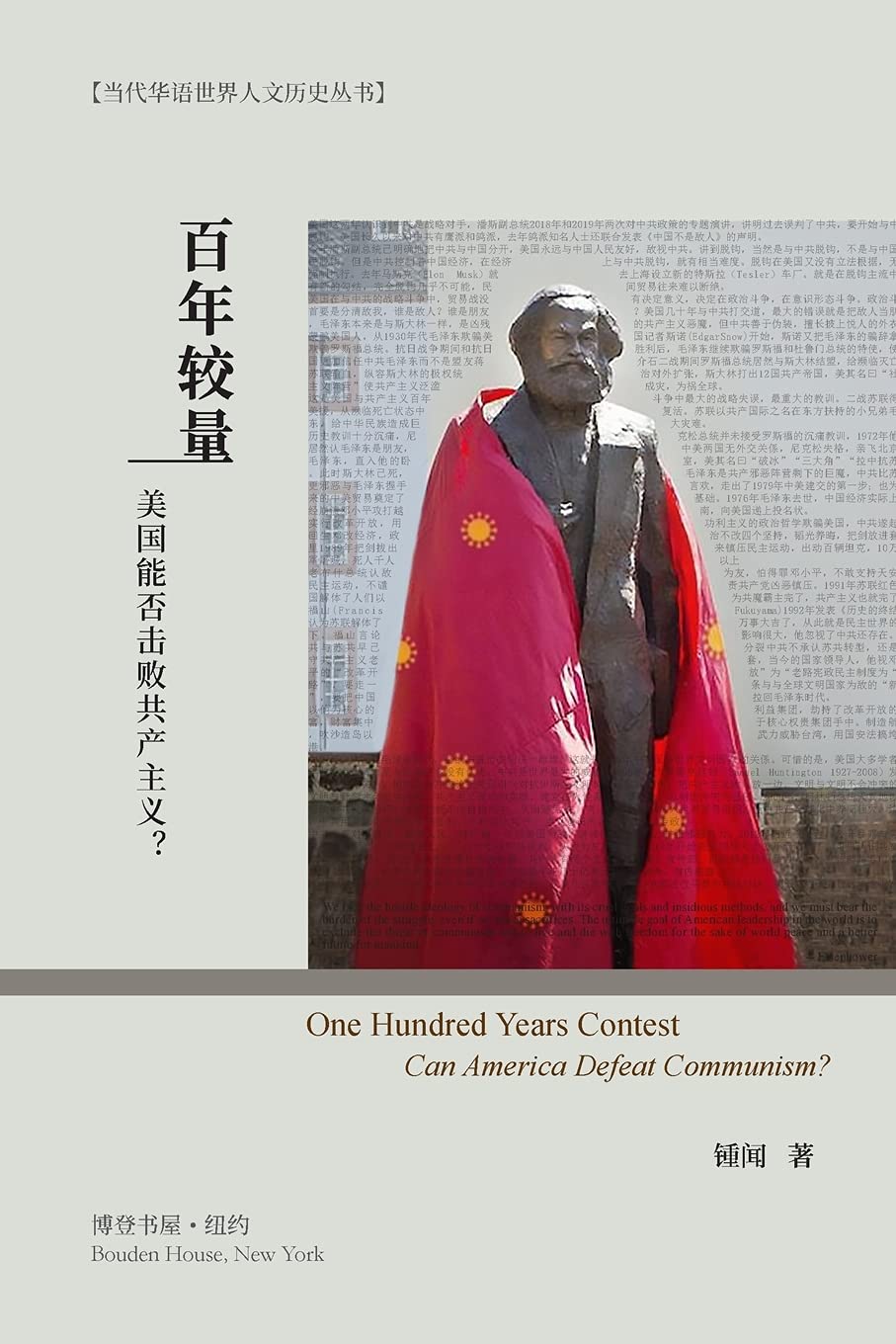
A Century-Long Contest
Chapter 21: Kissinger – Embracing the “Giant Panda” (Part II)
On November 6, 2019, the 96-year-old Henry Kissinger, undeterred by his age, flew to Beijing to pay homage to Xi Jinping. After the meeting, China’s official Xinhua News Agency released a photo of the reception along with a brief caption reporting that Kissinger said: “The U.S. and China should coexist and prosper together.” By CCP convention, any statements published by Xinhua are considered officially approved positions; other comments that do not conform to the Party’s narrative are often deliberately omitted. What else was discussed in the meeting was not disclosed by either side. Kissinger’s opposition to confronting the CCP, his rejection of containing the communist empire, and his call for “coexistence and mutual prosperity” clearly show a political tilt toward the CCP, acting as a lobbyist in their favor.
In 2020, at Bloomberg’s “New Economy Forum,” Kissinger said: “The United States and China are now two great powers with roughly equal strength. This is the first time in history that the two countries face each other in this way. We must avoid letting this confrontation escalate into conflict and instead attempt productive cooperation.” He noted that differences and clashes between the U.S. and China will persist, and the key question is whether a basis for cooperation can be found. Otherwise, such clashes could spiral into catastrophic consequences comparable to World War I.
Kissinger’s statements clearly sided with the CCP. Yet world history trends toward civilized democracy, not communism. The rise of the CCP is not a historical inevitability—it is largely the result of U.S. policy failures. How can China, as Xi Jinping hopes, claim equality with the United States? How can the U.S. seek a balance of power with the CCP? Kissinger’s insistence on preventing confrontation, warning that a conflict would result in mutual loss, effectively allows Xi Jinping to expand CCP influence globally under the guise of peaceful slogans, gradually replacing the U.S.’s current global dominance. Kissinger has, in effect, acted as the CCP’s protector.
The same Kissinger who went to Beijing with Nixon to “pay homage” to Mao Zedong, in 2019 still visited Xi Jinping, naively proclaiming that the U.S. should “coexist and prosper” with China. Fortunately, President Biden has a clear understanding of the CCP. Unlike Kissinger, Biden has not followed the advice to pursue a “coexistence and mutual prosperity” relationship. Instead, he has defined U.S.-China relations as a “fierce competition.” Biden stated: “We must prepare together for long-term strategic competition with China. How the U.S., Europe, and Asia work together to ensure peace, defend our shared values, and promote prosperity in the Indo-Pacific will be among the most influential efforts we undertake. Competition with China will be intense. This is what I anticipate and welcome because I believe in the global system that Europe, the U.S., and our allies in the Indo-Pacific have built over the past 70 years.” Clearly, China is not considered a cooperative partner in the global system.
Kissinger is hailed as a master of the balance-of-power theory in international politics, focusing on the Cold War bipolar environment, using diplomacy and alliances to counter Soviet dominance. In situations of disadvantage, the U.S. would unite various forces to restrain the Soviet Union, achieving a relative balance. Kissinger himself claims the title of “master of international balance,” seeing the U.S., China, and the Soviet Union as a “trilateral game,” imagining he successfully leveraged Mao to counter the USSR and secure a 2:1 U.S. advantage. However, Mao had no intention of helping the U.S. against the USSR, and by then China lacked the capacity to counter the Soviet Union; in fact, China had already fully split with the USSR in 1964. Kissinger’s “balance-of-power” fantasy was thus misplaced.
Kissinger also assumed that China could help the U.S. end the Vietnam War, unaware that the Viet Cong no longer obeyed Beijing. As soon as talks concluded, Zhou Enlai flew to Hanoi to brief the Viet Cong, only to be coldly rebuffed: “Vietnam’s own affairs don’t require China’s intervention.” In March 1972, the Viet Cong launched their planned full-scale attacks against U.S. forces, suffering heavy losses from American bombing. In reality, China had contributed nothing to ending the Vietnam War. Some commentators note that Kissinger’s balance-of-power theory laid a foundation for the West’s eventual Cold War victory and later became widely used in diplomacy. Yet sacrificing the Republic of China (Taiwan) to court the CCP did not solve the Vietnam problem—it saved the CCP, allowing the party, shaken by Cultural Revolution power struggles, to survive.
Zhong Wen concludes: Kissinger has shown virtually no willingness to confront communism. From his pro-Mao to pro-Xi stance, decades of support make him the CCP’s “giant panda,” scoring poorly in the struggle against humanity’s enemy. If graded, he would get 40 out of 100. However, under Biden, his position has shifted slightly. In a recent online event, he noted that the world currently faces greater dangers than before World War I, due to the advanced weapons technologies of the U.S. and China. He acknowledged that negotiating with China, which is rapidly gaining technological advantages in certain areas, is challenging, while praising China’s organizational capabilities in technological innovation. He emphasized that the U.S. and its allies must reach agreements with China on a new international order to maintain stability; otherwise, the world may again face a situation similar to that preceding World War I. He suggested that Western nations must “believe in themselves,” framing this as an internal problem rather than a “China problem.” This view inherits Chiang Kai-shek’s principle that “internal stability must precede external engagement,” raising hope that this long-time pro-CCP “thinker and giant panda” might contribute positively to world peace.
 正义钟声 Voice of Justice